Functional Medicine vs. Conventional Medicine: What's the Difference?
Functional Medicine vs. Conventional Medicine: Understanding the Differences—and Why the Best Care Uses Both
Written by Kerri Rachelle, PhD c., RDN, CSSD, FMP-AC
Founder & CEO, REV0lution | Doctor of Integrative & Natural Medicine Candidate
Reviewed for scientific accuracy: July 2026
Quick Answer
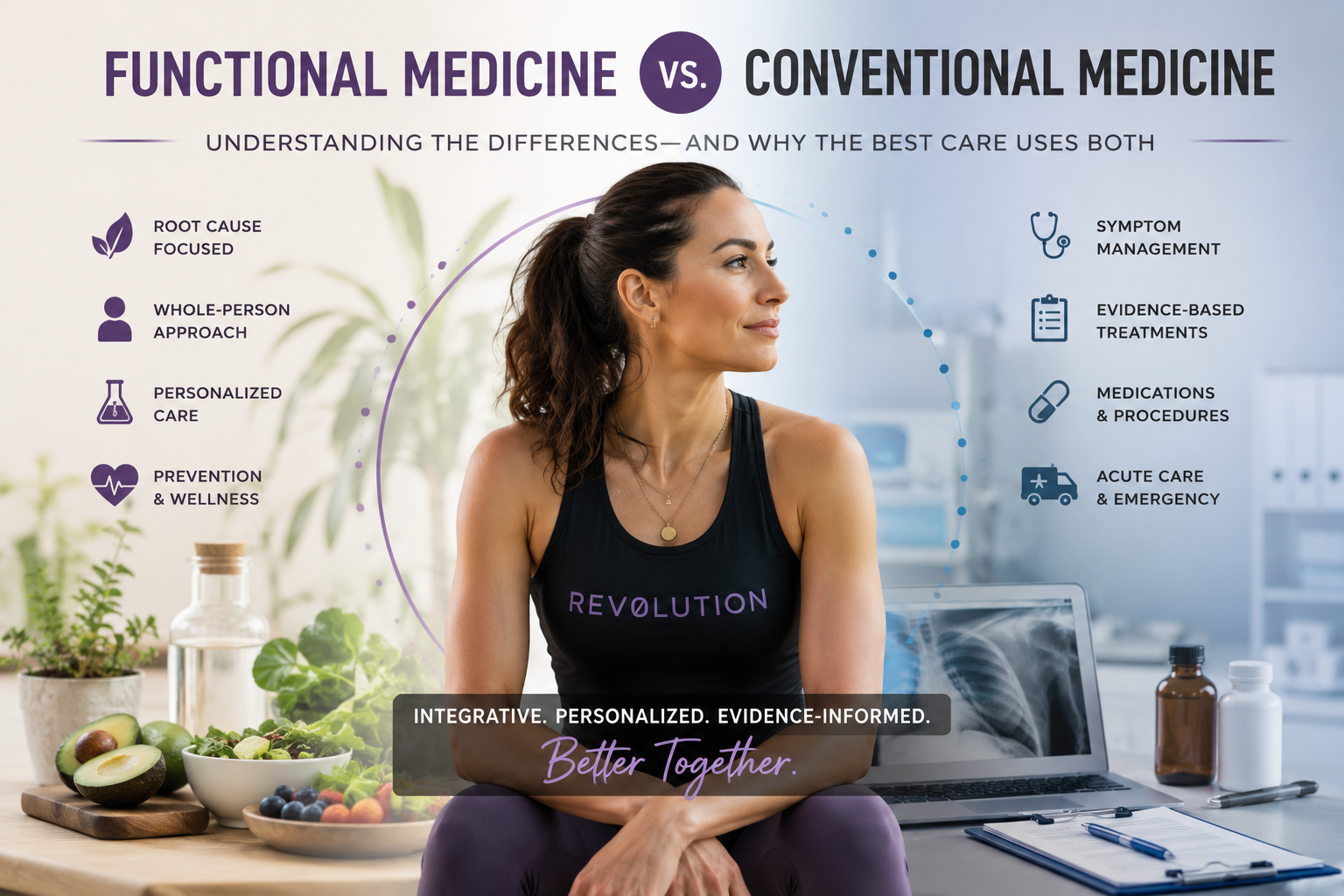
Functional medicine and conventional medicine are not competing approaches to healthcare—they are complementary. Conventional medicine excels at diagnosing and treating acute illness, trauma, infections, and medical emergencies. Functional medicine adds a personalized, systems-based approach that focuses on nutrition, lifestyle, prevention, and identifying the factors that may contribute to chronic disease. Together, they provide a more complete model of care.
Why Do People Compare Functional Medicine and Conventional Medicine?
If you've ever searched "functional medicine vs. conventional medicine," you've probably found articles suggesting you have to choose one or the other.
You don't.
The reality is that each model was developed to solve different problems. Conventional medicine has transformed modern healthcare through advances in emergency medicine, surgery, imaging, infectious disease treatment, and pharmaceuticals. Functional medicine has emerged in response to a different challenge: the growing burden of chronic disease and the need for more personalized, preventive care.
The future of healthcare isn't choosing between these models. It's understanding how they work together.
What Conventional Medicine Does Exceptionally Well
Modern medicine has dramatically increased life expectancy and improved survival from countless diseases. Many of the medical advances we benefit from today would not be possible without decades of scientific research, technological innovation, and standardized clinical care.
Conventional medicine is particularly effective for:
Emergency and trauma care
Heart attacks and strokes
Surgical procedures
Infectious disease treatment
Diagnostic imaging
Cancer treatment
Intensive care medicine
Acute medical stabilization
Management of complex medical conditions requiring medication or procedures
If someone is experiencing chest pain from a heart attack, severe trauma after a car accident, appendicitis, sepsis, or a stroke, conventional medicine provides the expertise and interventions needed to save lives.
It also plays an essential role in diagnosing disease. Blood work, imaging, pathology, genetic testing, and specialist evaluations help identify serious medical conditions and guide appropriate treatment.
These are extraordinary strengths that should never be minimized.
What Does Functional Medicine Add to Conventional Medicine?
Many of today's biggest health challenges aren't acute emergencies.
They're chronic conditions that develop over months or years.
These include:
Type 2 diabetes
Insulin resistance
Cardiovascular disease
Obesity
Autoimmune diseases
Digestive disorders
Chronic fatigue
Hormonal changes
Metabolic dysfunction
These conditions often involve multiple body systems and are influenced by nutrition, sleep, stress, physical activity, environmental exposures, genetics, medications, and other lifestyle factors.
Functional medicine expands the conversation by asking additional questions.
Instead of focusing only on the diagnosis, it also explores:
What factors may have contributed to this condition?
Which body systems appear to be interconnected?
Are there nutrition or lifestyle patterns influencing health?
What opportunities exist to improve overall function and reduce future disease risk?
Rather than replacing conventional care, functional medicine builds upon it.
How Does Functional Medicine Differ from Conventional Medicine?
One of the biggest differences between the two models is the questions they ask.
Conventional medicine often begins with:
What disease is present, and what is the most appropriate treatment?
Functional medicine also asks:
What factors may have contributed to this person's current health, and what can we improve moving forward?
Both questions matter.
One identifies disease.
The other helps build long-term health.
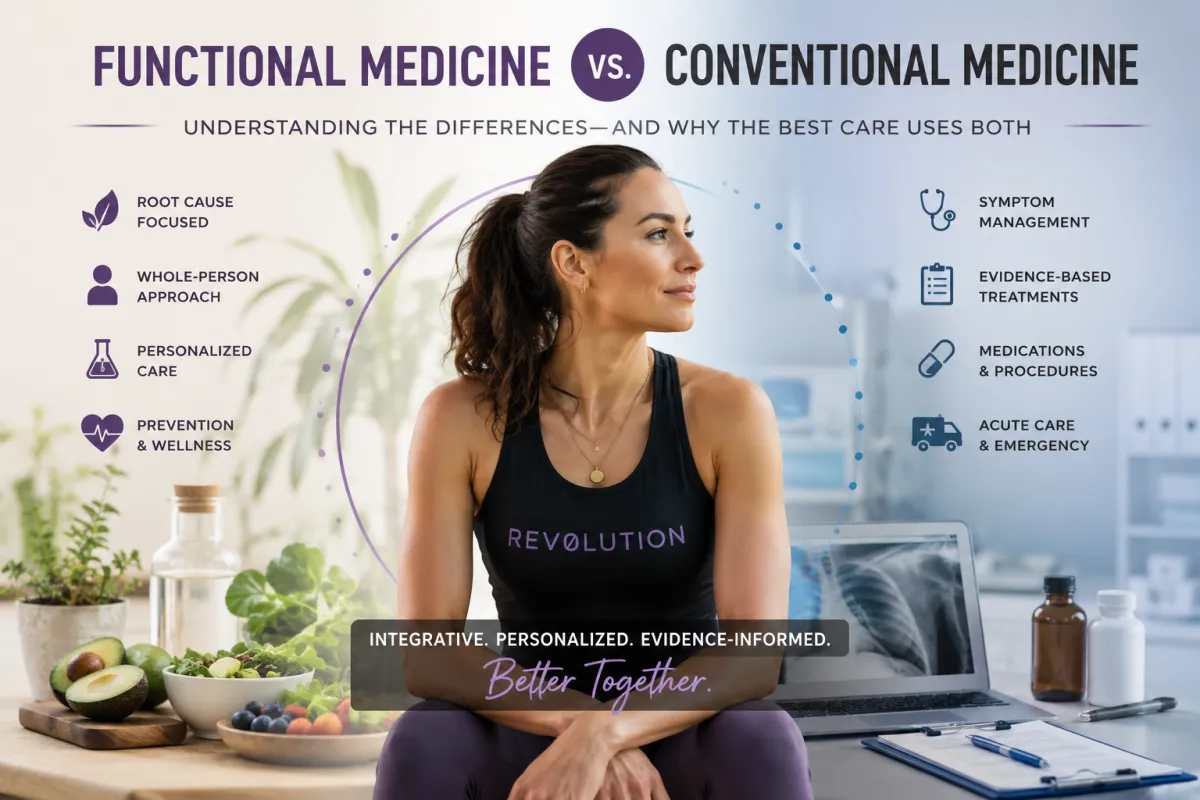
Functional Medicine vs. Conventional Medicine: Side-by-Side Comparison
Why Is Prevention Important in Functional Medicine?
One of the greatest strengths of functional medicine is its emphasis on prevention.
Chronic diseases now affect the majority of American adults and account for much of the nation's healthcare spending. Many of these conditions develop gradually, often influenced by years of dietary patterns, physical inactivity, inadequate sleep, chronic stress, tobacco use, excess alcohol, environmental exposures, and other modifiable factors.
Functional medicine prioritizes identifying these opportunities early.
Nutrition counseling.
Strength training.
Sleep optimization.
Stress resilience.
Blood sugar management.
Healthy body composition.
Cardiovascular risk reduction.
These interventions are not alternatives to good medical care—they are important components of it.
Why Is Personalized Healthcare Important?
Two people can receive the same diagnosis and still require very different treatment plans.
Consider two individuals with prediabetes.
One may have a strong family history, work night shifts, sleep five hours per night, and consume very little protein.
Another may have polycystic ovary syndrome, chronic stress, low muscle mass, and limited physical activity.
The diagnosis is the same.
The contributing factors are different.
Functional medicine recognizes these differences and builds personalized recommendations around the individual rather than relying solely on the diagnosis.
Can Functional Medicine and Conventional Medicine Work Together?
The strongest healthcare often combines the best aspects of both approaches.
For example:
A person with hypertension may benefit from medication to lower blood pressure while simultaneously improving nutrition, increasing physical activity, managing stress, optimizing sleep, and addressing excess body weight if appropriate.
Someone with inflammatory bowel disease may require prescription medications to control inflammation while also working with a registered dietitian to optimize nutrition, manage symptoms, monitor nutrient deficiencies, and improve quality of life.
A patient recovering from a heart attack may receive emergency cardiac care, medications, and procedures while participating in cardiac rehabilitation, improving dietary habits, increasing physical activity, and reducing future cardiovascular risk.
This is integrated care.
Not one approach replacing the other—but each contributing its strengths.
Common Myths About Functional Medicine and Conventional Medicine
"Functional medicine is anti-medication."
It shouldn't be.
Medications save lives every day and remain an essential part of healthcare. Functional medicine recognizes that medications are often appropriate while also exploring nutrition, lifestyle, and other evidence-informed strategies that may improve overall health.
"Conventional medicine ignores prevention."
Not entirely.
Many physicians counsel patients on healthy eating, exercise, smoking cessation, and preventive screenings. However, time constraints, reimbursement models, and healthcare system demands can make delivering comprehensive lifestyle counseling challenging.
"Functional medicine can cure every disease."
No healthcare model can make that claim.
Functional medicine is best viewed as an approach that seeks to optimize health by addressing modifiable contributors to disease while working alongside appropriate medical care.
The Future of Healthcare: Integrating Functional and Conventional Medicine
Healthcare is changing.
Patients increasingly want providers who can diagnose disease, explain what is happening, address lifestyle factors, personalize care, and work collaboratively across disciplines.
This isn't about replacing conventional medicine.
It's about expanding the conversation.
As healthcare continues to evolve, the greatest opportunity lies in combining the strengths of evidence-based medicine with personalized nutrition, lifestyle interventions, preventive care, and systems thinking.
Patients deserve both.
Bottom Line
Functional medicine and conventional medicine each play important roles in modern healthcare.
Conventional medicine provides exceptional care for emergencies, acute illness, diagnosis, surgery, and medical treatment.
Functional medicine adds a whole-person perspective by considering nutrition, lifestyle, prevention, behavior change, and the interactions between body systems that influence long-term health.
Together, these approaches create a more comprehensive model of care—one that helps people not only recover from illness, but also build and maintain better health over time.
Medical Disclaimer: This article is for general educational and informational purposes only and does not provide individualized medical or nutrition advice. It is not intended to diagnose, treat, cure, or prevent disease or replace care from a qualified healthcare professional. Do not change your medications, supplements, diet, fasting schedule, or healthcare plan based solely on this content. [Read the full Medical Disclaimer and Terms & Conditions.]
FAQ
Is functional medicine better than conventional medicine?
Neither approach is inherently better. Conventional medicine is essential for diagnosing and treating acute illness and medical emergencies, while functional medicine adds personalized strategies focused on nutrition, lifestyle, prevention, and long-term health.
Can functional medicine replace my primary care doctor?
No. Functional medicine is designed to complement—not replace—primary care and specialty medical care.
Why do people choose functional medicine?
Many people seek functional medicine for chronic symptoms, personalized nutrition guidance, prevention, and a more comprehensive understanding of factors that influence their health.
Is functional medicine evidence-based?
Many components of functional medicine—including nutrition therapy, physical activity, sleep, stress management, and chronic disease prevention—are strongly supported by scientific evidence. Other areas continue to evolve, making it important to work with qualified healthcare professionals who use evidence-informed practices.
What conditions may benefit from a functional medicine approach?
Functional medicine may support individuals with digestive disorders, insulin resistance, metabolic syndrome, PMOS (formerly PCOS), thyroid disorders, autoimmune diseases, cardiovascular risk factors, chronic fatigue, and other chronic health concerns alongside appropriate medical care.
Can I use both functional medicine and conventional medicine?
Yes. Many patients benefit from an integrated approach that combines conventional diagnosis and treatment with personalized nutrition, lifestyle interventions, and preventive strategies.
References
Centers for Disease Control and Prevention. About Chronic Diseases.
Centers for Medicare & Medicaid Services. National Health Expenditure Data.
Engel GL. The need for a new medical model: A challenge for biomedicine. Science. 1977;196(4286):129-136.
Bodenheimer T, Lorig K, Holman H, Grumbach K. Patient self-management of chronic disease in primary care. JAMA. 2002;288(19):2469-2475.
May C, Montori VM, Mair FS. We need minimally disruptive medicine. BMJ. 2009;339:b2803.
Bodai BI, Nakata TE, Wong WT, et al. Lifestyle Medicine: A Brief Review of Its Dramatic Impact on Health and Survival. The Permanente Journal. 2018;22:17-025.
Porter ME. What Is Value in Health Care? New England Journal of Medicine. 2010;363:2477-2481.
Kruk ME, Gage AD, Arsenault C, et al. High-quality health systems in the Sustainable Development Goals era: time for a revolution. The Lancet Global Health. 2018;6(11):e1196-e1252.
National Academies of Sciences, Engineering, and Medicine. Integrating Social Care into the Delivery of Health Care: Moving Upstream to Improve the Nation's Health. Washington, DC: The National Academies Press; 2019.