Gut-Brain Axis: How Your Brain and Digestion Connect
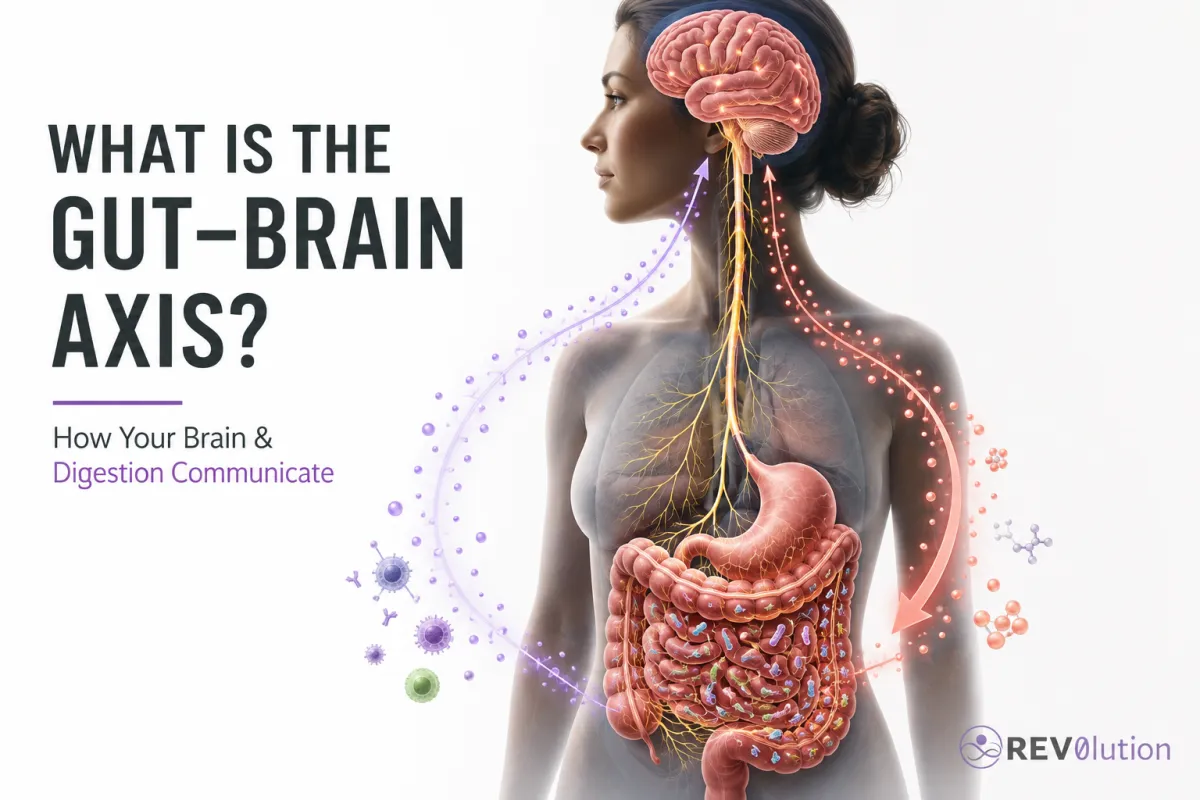
What Is the Gut-Brain Axis? How Your Brain and Digestion Communicate
Written by Kerri Rachelle, PhD(c), RDN, CSSD, FMP-AC
Founder & CEO, REV0lution | Doctor of Integrative & Natural Medicine Candidate
Quick Answer
The gut-brain axis is the two-way communication system connecting the brain and digestive tract through nerves, hormones, immune signals and microbial metabolites.
Key Takeaways
The brain can influence digestion, and digestive activity can send information back to the brain.
The vagus nerve is important, but it is only one part of the communication system.
The enteric nervous system helps regulate movement, secretion and blood flow within the gut.
The HPA axis connects stress physiology with digestive, immune and nervous-system function.
Gut-brain symptoms are biological and real; they are not evidence that symptoms are imagined.
What Is the Gut-Brain Axis?
The gut-brain axis is a communication network involving the brain, spinal cord, autonomic nervous system, enteric nervous system, digestive organs, immune system and intestinal microbiome.
This communication travels in both directions. The brain can alter intestinal movement, secretion, appetite, sensitivity and blood flow. At the same time, the digestive tract sends the brain information about stretching, nutrients, inflammation, microbial activity and the internal condition of the body.
This helps explain why stress can change bowel habits, why digestive discomfort can affect concentration or mood and why some gastrointestinal conditions are now described as disorders of gut-brain interaction.
The phrase “gut-brain axis” is not a metaphor. It describes a collection of measurable biological pathways.
What Is the Enteric Nervous System?
The enteric nervous system is a network of neurons located within the walls of the digestive tract. It helps coordinate peristalsis, intestinal secretion, local blood flow and communication among different areas of the gut.
It is sometimes called the “second brain” because it contains extensive neural circuitry and can coordinate many digestive activities locally. However, it does not think, reason or function as a second conscious brain.
The enteric nervous system continuously exchanges information with the central nervous system through the vagus nerve, spinal pathways and autonomic signaling. Digestion therefore involves both local control and communication with the brain.
What Does the Vagus Nerve Do for Digestion?
The vagus nerve is one of the major communication routes between the digestive tract and brainstem. It carries information in both directions, although much of its activity involves sensory information traveling from the body toward the brain.
Vagal pathways help communicate information about fullness, nutrients, inflammation and digestive activity. Signals traveling from the brain can also influence gastric function, pancreatic secretion and intestinal movement.
The vagus nerve is sometimes presented online as an on-off switch for digestive health. It is more accurate to view it as one part of a larger regulatory network. Spinal nerves, hormones, immune mediators, intestinal neurons and circulating metabolites also contribute.
Low “vagal tone” cannot be diagnosed from bloating, constipation or anxiety alone, and stimulating the vagus nerve is not a universal solution for digestive symptoms.
How Does the Autonomic Nervous System Affect Digestion?
The autonomic nervous system helps regulate functions that occur without conscious control. Its sympathetic and parasympathetic divisions adjust digestion according to the body’s circumstances.
During a period of perceived danger or high demand, sympathetic activity can redistribute resources and change gastric emptying, intestinal transit, secretion and sensitivity. During safer or more settled conditions, parasympathetic activity generally supports coordinated digestive activity.
The familiar statement that stress “shuts down digestion” is too absolute. Digestion does not simply turn off. Different parts of the gastrointestinal tract may respond differently. Stomach emptying may slow while colonic activity increases, for example.
The response also varies among individuals. One person develops constipation during stress, another develops urgent diarrhea and another primarily experiences reflux, nausea or abdominal pain.
How Does the HPA Axis Affect the Gut-Brain Connection?
The autonomic nervous system is not the only pathway carrying stress signals between the brain and digestive tract. The hypothalamic-pituitary-adrenal axis, or HPA axis, also helps organize the body’s response to perceived threat, illness and physiological demand.
The hypothalamus releases corticotropin-releasing hormone, or CRH. CRH signals the pituitary gland to release ACTH, which then signals the adrenal glands to produce cortisol. These hormones interact with the autonomic nervous system, immune system and gastrointestinal tract.
CRH signaling also occurs locally within the gut and can affect mast cells positioned near intestinal nerves and blood vessels. Through these pathways, stress may influence motility, secretion, intestinal permeability, inflammation and visceral sensitivity.
The stress response is not inherently harmful. It is an adaptive system designed to help the body respond to demand. Problems may develop when stress activation becomes persistent, recovery is inadequate or an already-sensitive gastrointestinal system repeatedly receives signals of threat.
This does not mean every digestive symptom results from high cortisol or “adrenal fatigue.” A single cortisol measurement cannot explain the entire gut-brain axis. It does mean that stress physiology deserves legitimate clinical attention rather than being dismissed as purely emotional.
How Does the Brain Know What Is Happening in the Gut?
The nervous system continuously monitors internal signals through a process called interoception.
Stomach stretching, intestinal contractions, inflammation, nutrient exposure and chemical signals can activate sensory pathways. The brain then interprets those signals using immediate physiological information as well as previous experiences, attention, emotional state and expectations.
This does not mean symptoms are invented. It means that symptom intensity is determined by more than the amount of gas, acid or stool physically present.
For example, two people may experience a similar degree of intestinal stretching but perceive it very differently. A sensitized nervous system may interpret an ordinary digestive sensation as painful, urgent or threatening.
This sensitivity can develop after infection, inflammation, repeated pain, trauma or other experiences that teach the nervous system to respond more strongly to internal signals. The resulting symptoms are physiologically real even when imaging or endoscopy does not reveal structural damage.
How Do Hormones Carry Messages Between the Gut and Brain?
Specialized cells in the digestive tract sense nutrients and release hormones such as cholecystokinin, peptide YY and glucagon-like peptide-1.
These hormones help coordinate digestion, appetite, insulin secretion, stomach emptying and fullness. Some act through the bloodstream, while others communicate with nearby nerves that relay information toward the brain.
Hunger and fullness therefore reflect more than willpower or stomach volume. They emerge from communication among the digestive tract, brain, hormones, recent food intake, sleep, activity and metabolic state.
Changes in stomach emptying, appetite hormones, glucose regulation, medication or gastrointestinal function may affect how quickly someone becomes hungry, how full she feels and how comfortable she feels after eating.
How Does the Immune System Participate in the Gut-Brain Axis?
Immune cells in the gut monitor the intestinal environment and communicate through chemical messengers such as cytokines. Those signals can affect local nerves, barrier function and systemic inflammatory activity.
The brain can also influence immune function through autonomic and endocrine pathways. This creates another two-way route connecting stress physiology, digestion and inflammation.
The intestinal epithelium is largely one cell thick, but it is supported by mucus, tight junctions, antibodies, resident microbes and extensive immune tissue. When this barrier is disrupted, immune cells may encounter more microbial products, antigens or food-derived material.
Immune activity can also affect nerves, sensitivity and behavior during illness. The fatigue, reduced appetite and desire to rest that accompany an infection are examples of immune signals affecting the brain.
This does not establish that every change in mood or cognition begins with intestinal inflammation. It means immune signaling is one mechanism through which events in the gut may be communicated beyond the digestive tract.
How Does the Gut Microbiome Communicate With the Brain?
Gut microbes process food components and produce many biologically active substances. These include short-chain fatty acids, bile-acid derivatives, tryptophan metabolites and other compounds that may interact with intestinal cells, immune cells and nerves.
Some microbial metabolites enter circulation. Others work locally by influencing the intestinal barrier, stimulating hormone release or interacting with sensory pathways, including the vagus nerve.
Animal studies have revealed detailed mechanisms connecting microbial changes with behavior, stress responses and brain development. Human research has also identified associations among microbial patterns, gastrointestinal conditions and some neurological or psychiatric disorders.
However, translation into clinical care remains limited. A microbial association does not prove that a particular organism caused someone’s anxiety, depression, fatigue or brain fog. It also does not establish that changing one bacterium will correct those symptoms.
The microbiome matters, but it should not be turned into another simplified explanation for every symptom.
Does the Gut Really Produce Most of the Body’s Serotonin?
Much of the body’s serotonin is produced in the gastrointestinal tract, primarily by enterochromaffin cells rather than by microbes themselves. Microbial metabolites may influence that production.
Gut serotonin helps regulate motility, secretion, nausea, blood-vessel activity and platelet function. It is not the same pool of serotonin used for signaling within the brain because peripheral serotonin does not freely cross the blood-brain barrier.
The gut may still influence serotonin-related pathways in the brain indirectly through neural signals, immune activity and tryptophan metabolism.
Saying that “the gut produces serotonin, so it controls happiness” skips several important biological steps. Gut serotonin is important, but it should not be used as a simplistic explanation for depression, anxiety or emotional well-being.
Can Gut Problems Cause Anxiety or Depression?
Digestive conditions and mental-health symptoms frequently overlap. Persistent pain, unpredictable bowel habits, restricted eating and fear of symptoms can understandably affect mood and quality of life.
At the same time, anxiety, depression, trauma and chronic stress may alter attention, sensitivity, appetite, eating behavior and digestive function. Microbiome and immune pathways may also contribute in some circumstances.
Current evidence does not support reducing anxiety or depression to a gut-bacteria problem. Mental-health symptoms deserve appropriate care, and digestive symptoms deserve appropriate care.
Addressing one does not invalidate the other. Neither should be used as a reason to ignore medical, nutritional or psychological evaluation.
What Are Disorders of Gut-Brain Interaction?
Disorders of gut-brain interaction are conditions in which symptoms arise from changes in digestive movement, sensitivity, immune activity, microbial function and the way the nervous system processes intestinal signals.
Examples include irritable bowel syndrome and functional dyspepsia. These conditions can cause substantial pain, bloating, nausea, constipation, diarrhea or uncomfortable fullness even when routine imaging or endoscopy does not reveal a structural abnormality.
“Functional” does not mean imaginary. It means the problem may involve how the system functions rather than a visible structural injury.
These conditions do not result exclusively from stress. They are multifactorial and may involve:
Altered motility
Visceral hypersensitivity
Previous gastrointestinal infection
Immune activation
Food-related triggers
Microbial changes
Barrier dysfunction
Nervous-system processing
Stress physiology
A patient can have very real and disruptive symptoms even when conventional testing appears normal.
Can Gut-Brain Dysfunction Cause Brain Fog?
Brain fog is not a medical diagnosis, and it does not have one universal cause. People use the term to describe difficulty concentrating, slower thinking, forgetfulness or feeling mentally unclear.
Digestive illness may contribute indirectly through inadequate intake, nutrient deficiencies, disrupted sleep, pain, inflammation, medication effects or fear around eating. Iron deficiency, vitamin B12 deficiency, thyroid dysfunction, glucose dysregulation and other medical concerns can produce similar symptoms.
The gut-brain axis provides several biologically plausible pathways through which digestive and systemic health could influence cognition. It does not justify attributing every case of brain fog to dysbiosis or leaky gut without a broader evaluation.
How Can the Gut-Brain Connection Be Evaluated?
There is no single blood, stool or nervous-system test that measures the entire gut-brain axis.
Evaluation begins with symptoms, medical history, bowel patterns, food intake, sleep, stress, medication use, menstrual history when relevant and warning signs. Additional testing should answer a defined clinical question rather than attempt to prove that the “axis is broken.”
As explained in our article on functional medicine laboratory testing, a result becomes useful when it can be interpreted accurately and meaningfully guide the next clinical decision.
Testing may be appropriate when evaluating infection, inflammation, celiac disease, anemia, thyroid dysfunction, nutrient deficiency, glucose dysregulation or another suspected condition. It should be selected according to the clinical picture rather than ordered as a universal gut-brain panel.
What Supports Healthy Gut-Brain Communication?
Healthy gut-brain communication depends on more than vagus-nerve exercises or a probiotic. It requires coordinated digestion, adequate nourishment, regular elimination, appropriate movement, protected sleep and enough recovery from physiological and psychological stress.
Food provides the amino acids, fatty acids, carbohydrates, fiber, vitamins and minerals used throughout the nervous, immune and endocrine systems. Chronically under-eating, skipping meals, following unnecessarily restrictive diets or relying on artificially sweetened and heavily manufactured substitutes can make it harder to meet those needs.
Fiber and whole-food carbohydrates can support microbial metabolism, but the type and amount should fit the individual. Someone with significant bloating, impaired motility, inflammatory disease or another digestive disorder may not tolerate the same foods or quantities as someone without symptoms.
Regular movement can support motility and metabolic health. Sleep helps regulate stress signaling, appetite, immune activity and symptom perception. Addressing constipation, diarrhea, reflux, inadequate intake, iron or vitamin deficiencies and medication effects may also improve how someone feels far beyond the digestive tract.
These foundations are not universal cures. They create a more supportive physiological environment while persistent symptoms are properly evaluated and treated.
When Should Gut-Brain Symptoms Be Evaluated?
Persistent or worsening digestive symptoms deserve evaluation—particularly when they interfere with eating, sleeping, working, exercising or participating in everyday life.
Seek medical care for symptoms such as:
Blood in the stool
Black stool
Unexplained weight loss
Anemia
Fever
Persistent vomiting
Difficulty swallowing
Severe or persistent diarrhea
Symptoms that regularly wake you from sleep
A significant change in bowel habits
New neurological symptoms
Severe or rapidly worsening pain
Digestive symptoms should not automatically be attributed to stress, anxiety or dysbiosis. Mental-health symptoms should not automatically be attributed to the microbiome.
Responsible care considers both sides of the gut-brain relationship while evaluating other medical, nutritional and psychological contributors.
The Bottom Line
The gut-brain axis is a real, two-way biological communication system. The vagus nerve, enteric nervous system, autonomic nervous system, HPA axis, hormones, immune mediators and microbial metabolites all contribute.
This connection helps explain why emotional and physiological stress can affect digestion and why digestive symptoms can influence energy, concentration, appetite and mood.
It does not mean every neurological or psychological symptom begins in the gut—or that every digestive symptom is caused by stress.
Useful gut-brain care takes both sides of the conversation seriously. It supports adequate nutrition, sleep, movement, motility and stress recovery while investigating the medical and physiological reasons symptoms may be occurring.
Medical Disclaimer: This article is for general educational and informational purposes only and does not provide individualized medical or nutrition advice. It is not intended to diagnose, treat, cure, or prevent disease or replace care from a qualified healthcare professional. Do not change your medications, supplements, diet, fasting schedule, or healthcare plan based solely on this content. [Read the full Medical Disclaimer and Terms & Conditions.]
Frequently Asked Questions
What is the gut-brain axis in simple terms?
It is the communication system connecting the brain and digestive tract. Messages travel through nerves, hormones, immune signals and substances produced during digestion and microbial metabolism.
Is the vagus nerve the same as the gut-brain axis?
No. The vagus nerve is an important communication route, but the gut-brain axis also includes spinal pathways, the enteric nervous system, hormones, HPA-axis activity, immune signaling and microbial metabolites.
Is the enteric nervous system really a second brain?
It is called the second brain because it contains a large neural network capable of coordinating many digestive functions locally. It is not a second conscious or thinking brain.
How does the HPA axis affect digestion?
The HPA axis coordinates part of the stress response through CRH, ACTH and cortisol. These signals can interact with autonomic activity, immune function, mast cells, motility, secretion, permeability and digestive sensitivity.
Does gut serotonin improve mood?
Serotonin produced in the gut helps regulate digestive and peripheral functions but does not freely enter the brain. Gut activity may influence brain signaling indirectly, but gut serotonin should not be equated with happiness or used as a simple explanation for mood.
Can poor gut health cause brain fog?
Digestive illness, inadequate nourishment, poor sleep, anemia, thyroid dysfunction, medication effects, inflammation and other conditions may contribute to brain fog. The symptom is nonspecific and should not automatically be attributed to the microbiome.
Can anxiety cause real digestive symptoms?
Yes. Anxiety can influence motility, sensitivity, eating patterns, HPA-axis activity and autonomic signaling. The resulting symptoms are physiologically real, but anxiety should not be assumed to be the only cause without an appropriate evaluation.
Can probiotics repair the gut-brain axis?
No probiotic product has been shown to universally repair the gut-brain axis. Effects vary by strain, condition and individual, and the human evidence is not strong enough to treat probiotics as a universal answer for digestive or mental-health symptoms.
References
Cryan JF, O’Riordan KJ, Cowan CSM, et al. The Microbiota-Gut-Brain Axis. Physiol Rev. 2019;99(4):1877–2013. PMID: 31460832.
Morais LH, Schreiber HL 4th, Mazmanian SK. The Gut Microbiota-Brain Axis in Behaviour and Brain Disorders. Nat Rev Microbiol. 2021;19(4):241–255. PMID: 33093662.
Margolis KG, Cryan JF, Mayer EA. The Microbiota-Gut-Brain Axis: From Motility to Mood. Gastroenterology. 2021;160(5):1486–1501. PMID: 33493503.
Furness JB. The Enteric Nervous System and Neurogastroenterology. Nat Rev Gastroenterol Hepatol. 2012;9(5):286–294. PMID: 22392290.
Agirman G, Yu KB, Hsiao EY. Signaling Inflammation Across the Gut-Brain Axis. Science. 2021;374(6571):1087–1092. PMID: 34822299.
Yano JM, Yu K, Donaldson GP, et al. Indigenous Bacteria From the Gut Microbiota Regulate Host Serotonin Biosynthesis. Cell. 2015;161(2):264–276. PMID: 25860609.
Vanuytsel T, van Wanrooy S, Vanheel H, et al. Psychological Stress and Corticotropin-Releasing Hormone Increase Intestinal Permeability in Humans by a Mast Cell-Dependent Mechanism. Gut. 2014;63(8):1293–1299. PMID: 24153250.
Gerdin L, et al. Acute Psychological Stress Increases Paracellular Permeability and Modulates Immune Activity in Rectal Mucosa of Healthy Volunteers. United European Gastroenterol J. 2023;11(1):31–41. PMID: 36314901.
de Punder K, Pruimboom L. Psychosocial Stress-Induced Intestinal Permeability in Healthy Humans: What Is the Evidence? Clin Exp Gastroenterol. 2023. PMID: 37842017.
Drossman DA. Functional Gastrointestinal Disorders: History, Pathophysiology, Clinical Features and Rome IV. Gastroenterology. 2016;150(6):1262–1279.e2. PMID: 27144617.