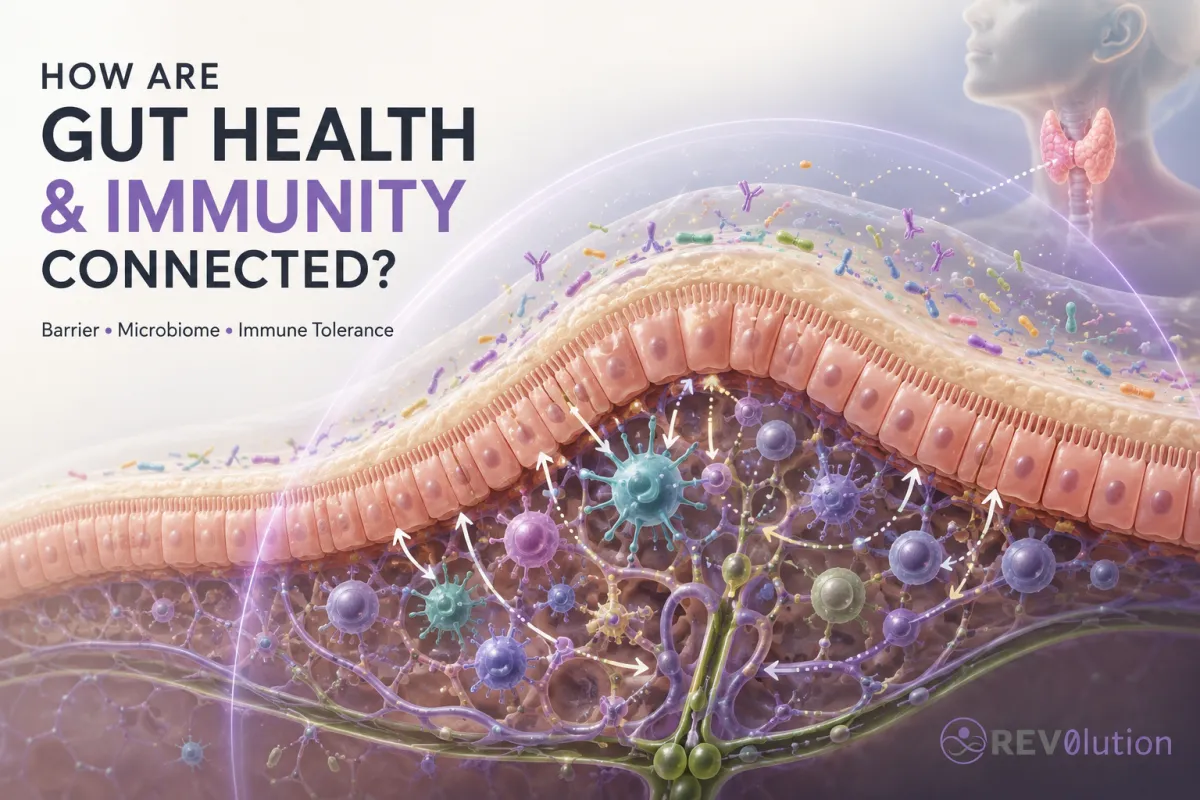
Gut Health and the Immune System: How They Connect
How Are Gut Health and the Immune System Connected?
Written by Kerri Rachelle, PhD(c), RDN, CSSD, FMP-AC
Founder & CEO, REV0lution | Doctor of Integrative & Natural Medicine Candidate
Quick Answer
The intestinal lining, gut microbes and immune system communicate continuously. This relationship helps the body absorb nutrients, tolerate food and resident microbes, and respond to genuine threats. Gut dysfunction can influence immune symptoms and autoimmune health, but it is one part of a larger clinical picture.
Key Takeaways
The intestinal epithelium is largely one cell thick and sits directly above an extensive immune network.
Gut immunity must defend against pathogens without overreacting to food or resident microbes.
Stress, sleep, environmental exposures, nutrition and intestinal permeability can influence gut–immune communication.
Improving gastrointestinal function can meaningfully help many people with Hashimoto’s and other autoimmune conditions.
Gut-focused care should support medical treatment—not replace appropriate diagnosis or prescribed medication.
How Are Gut Health and the Immune System Connected?
Every meal brings the intestinal immune system into contact with nutrients, food proteins, microorganisms and environmental compounds. It must continuously distinguish what can be absorbed or tolerated from what needs to be contained or challenged.
The intestinal immune system manages this boundary through communication among epithelial cells, mucus, microorganisms, antibodies, nerves and specialized immune tissue.
These systems do not operate independently. Microbes affect immune signaling, immune activity influences which organisms can live near the intestinal surface, and the intestinal barrier helps determine which substances remain within the digestive tract.
Gut and immune health are therefore closely connected—but connected does not mean interchangeable. Gut dysfunction can affect immune regulation without explaining every infection, allergy or autoimmune condition.
Why Is the Intestinal Immune System So Important?
The contents of the digestive tract are separated from the tissues beneath them by an epithelial lining that is largely only one cell thick. That single layer extends across an enormous interface where food, microbes, medications, environmental compounds and immune tissue meet.
The lining is not working alone. Mucus, tight junctions, antimicrobial compounds, secretory IgA, resident microbes, blood flow and rapid cellular renewal provide overlapping layers of protection. Beneath the epithelial cells sits an extensive immune network prepared to respond when that boundary is crossed.
This arrangement allows efficient communication and nutrient absorption. It also means that barrier integrity, microbial activity and immune signaling are inseparable.
The immune system must remain alert enough to recognize a genuine threat without responding aggressively to every meal or resident organism. That constant balance between defense and tolerance is one of the intestinal immune system’s most important jobs.
What Is Gut-Associated Lymphoid Tissue?
Gut-associated lymphoid tissue, or GALT, includes organized and dispersed immune structures throughout the digestive tract.
It includes Peyer’s patches in the small intestine, isolated lymphoid follicles and immune cells distributed through the intestinal lining and underlying tissue. These structures sample material from the intestinal environment and help coordinate appropriate responses.
Some responses are defensive. Others promote tolerance, preventing the immune system from reacting aggressively to every harmless food protein or resident organism.
You may have heard that a specific percentage of the immune system “lives in the gut.” The intestine is unquestionably one of the body’s largest immune compartments, but assigning one precise percentage is less useful than understanding what this tissue does.
How Does the Gut Decide What Is Dangerous?
The intestinal immune system uses both innate and adaptive defenses.
Innate immunity provides the immediate response. Epithelial cells, macrophages, dendritic cells, mast cells and other immune cells recognize patterns associated with microorganisms or tissue damage. They release signals that help contain threats, recruit additional defenses and initiate tissue repair.
Adaptive immunity creates more specific responses. T cells help coordinate or regulate immune activity, while B cells can produce antibodies such as secretory IgA. Regulatory T cells are particularly important because they help prevent unnecessary reactions to food proteins and resident microbes.
Specialized intestinal structures sample material from the digestive tract so the immune system can determine whether to tolerate it, contain it or mount a stronger defense.
That decision depends on:
The organism or antigen encountered
Previous exposure
Genetic susceptibility
Barrier integrity
Microbial signals
Immune regulation
The surrounding inflammatory environment
Environmental and physiological stressors
The process is sophisticated—but not infallible. Infection, injury, chronic inflammation, altered microbial signaling and environmental exposures may shift the balance between tolerance and defense.
How Does the Gut Learn to Tolerate Food and Resident Microbes?
The digestive tract encounters foreign material at every meal, but “foreign” does not automatically mean dangerous.
Immune tolerance allows the body to encounter food proteins and resident microorganisms without launching an unnecessary inflammatory response. Regulatory immune cells, antigen-presenting cells, epithelial signals, antibodies and microbial products all participate.
Tolerance is an active process. The immune system is continuously distinguishing among harmless exposure, beneficial or neutral organisms and genuine threats.
When tolerance breaks down, inappropriate immune reactions may occur. That breakdown can involve genetics, infection, environmental exposure, barrier disruption, microbial activity and altered immune regulation. It should not automatically be blamed on one food or one missing bacterial species.
What Does Secretory IgA Do?
Secretory immunoglobulin A, or secretory IgA, is an antibody released across mucosal surfaces, including the intestinal lining.
It can bind microorganisms and antigens inside the digestive tract, reduce microbial attachment to the epithelial surface and help keep resident organisms appropriately contained. Secretory IgA participates in both immune defense and tolerance rather than simply destroying everything it recognizes.
A stool secretory-IgA result is sometimes presented as a complete measurement of gut or immune health. It is not.
Levels may vary with infection, stress, inflammation, immune conditions, collection methods and other factors. A high or low result may provide context in a carefully selected evaluation, but it cannot independently diagnose weak immunity, food sensitivity, autoimmune disease or the cause of someone’s symptoms.
How Does the Gut Microbiome Influence Immunity?
Gut microbes communicate with the immune system through their cellular structures, genetic material and metabolic products.
Certain organisms ferment food components and produce short-chain fatty acids such as butyrate, acetate and propionate. These compounds interact with intestinal cells, energy metabolism, barrier function and immune regulation. Other organisms modify bile acids or produce compounds that interact with receptors on intestinal and immune cells.
The microbiome also helps shape immune development, particularly early in life.
These mechanisms are biologically important, but one organism should not be labeled universally good or bad. Many detailed findings come from animal models, isolated cells or highly controlled experiments. Human immune health cannot yet be predicted from the abundance of one organism or one microbial metabolite.
A microbiome report can provide selected information. It cannot recreate the full microbial ecosystem or tell us precisely how every organism is behaving inside an individual person.
How Does Intestinal Permeability Affect Immune Exposure?
When intestinal permeability increases, immune cells beneath the epithelial lining may encounter more microbial products, antigens or food-derived material. This can contribute to immune activation in certain conditions.
The relationship also works in reverse. Infection and inflammation can damage the barrier and increase permeability. Barrier dysfunction may therefore be a contributor, consequence or both.
This is particularly relevant in diseases such as celiac disease and inflammatory bowel disease. It does not establish increased permeability as the cause of every autoimmune or inflammatory condition.
Our article on What Is Leaky Gut? explains the one-cell epithelial lining, tight junctions, stress physiology, environmental exposures and permeability testing in greater detail.
How Do Stress and the HPA Axis Affect Gut–Immune Communication?
Stress influences the gut through measurable nervous-system, hormonal and immune pathways.
The hypothalamic-pituitary-adrenal axis, or HPA axis, helps coordinate the stress response. The hypothalamus releases corticotropin-releasing hormone, or CRH. CRH signals the pituitary gland to release ACTH, which then signals the adrenal glands to produce cortisol.
The sympathetic nervous system simultaneously affects blood flow, intestinal secretion, motility and immune activity. The gastrointestinal tract also has local CRH signaling and its own extensive nervous system.
CRH can affect mast cells located close to intestinal nerves and blood vessels. When activated, mast cells release compounds that may influence permeability, inflammation and visceral sensitivity.
Human studies suggest that acute psychological stress can increase intestinal permeability or alter mucosal immune activity in some circumstances, although responses vary. Stress may also change motility, intensify pain, disrupt sleep, alter food intake and make the intestinal environment less resilient.
Symptoms should never be dismissed as “just stress.” Stress physiology can produce real changes in digestive and immune function. At the same time, stress should not automatically be declared the sole root cause of a persistent condition.
Can Environmental Exposures Affect Gut and Immune Health?
The gastrointestinal tract is one of the body’s primary contact points with environmental compounds entering through food and water.
Researchers are investigating how air pollutants, pesticides, heavy metals, PFAS, microplastics and other environmental toxicants may influence microbial communities, mucus, oxidative stress, epithelial integrity and immune signaling.
Some of the strongest mechanistic evidence comes from cell and animal research. Direct human evidence remains less complete and varies according to the substance, amount, duration and route of exposure.
That limitation should prevent exaggerated diagnoses, but it should not be converted into the assumption that avoidable exposure is irrelevant.
REV0lution supports practical exposure reduction without fear-based detoxification protocols. Reducing unnecessary plastic contact with hot food, avoiding smoking, following workplace protections, washing produce and investigating known water or environmental concerns are reasonable actions.
Diagnosing “toxin overload” from fatigue, bloating or a broad commercial panel is not.
The intestinal immune system also encounters microbial products naturally produced within the gut. When the barrier is disrupted, greater immune exposure to some of these products may influence inflammatory signaling. That is different from claiming that every symptom results from unspecified toxins circulating throughout the body.
Does Sleep Affect Gut–Immune Function?
Sleep and circadian rhythms help coordinate immune activity, hormone signaling, appetite, meal timing and gastrointestinal function. Sleep disruption may affect inflammatory signaling, microbial rhythms, food choices and digestive symptoms.
Human research is not uniform enough to say that one poor night of sleep damages the intestinal barrier or causes autoimmune disease. Sleep remains foundational because chronically disrupted sleep changes the physiological environment in which immune regulation and recovery occur.
Sleep should be protected as part of comprehensive care—not marketed as a standalone cure for a complex immune condition.
Does Every Autoimmune Disease Begin in the Gut?
There is no one absolute for where autoimmune disease may begin, but that does not mean the gut is irrelevant.
The microbiome and intestinal barrier are being studied in Hashimoto’s thyroiditis, rheumatoid arthritis, multiple sclerosis, type 1 diabetes, inflammatory bowel disease and other immune-mediated conditions. Researchers have identified associations and plausible mechanisms, but their strength and clinical meaning differ among diseases.
Autoimmune disease may involve genetics, infection, hormones, environmental exposure, immune regulation, tissue-specific processes and other interacting influences. Different autoimmune diseases do not share one universal origin.
A genuine root-cause approach considers these overlapping contributors. It does not replace one oversimplified explanation with another.
How Can Improving Gut Health Help Someone With Hashimoto’s?
In clinical practice, we often see patients with Hashimoto’s feel significantly better when coexisting gastrointestinal dysfunction is identified and addressed.
Improvements may include better digestion, more regular bowel movements, less bloating, greater food tolerance, improved energy and more reliable nutrient and medication absorption.
Several factors may help explain this response. Hashimoto’s can coexist with celiac disease, autoimmune gastritis, altered motility, constipation, iron or vitamin B12 deficiency and other digestive or absorptive concerns. Hypothyroidism itself may slow gastrointestinal movement, while gastrointestinal disease may interfere with thyroid-medication and nutrient absorption.
Researchers have also identified differences in microbial composition, immune signaling and intestinal-barrier markers among people with Hashimoto’s. The gut is therefore not a side issue simply because research has not established one universal gut cause or one standardized gut treatment for the condition.
At REV0lution, improving gut health means more than prescribing probiotics or removing foods. It may include:
Evaluating persistent digestive symptoms
Supporting regular motility and elimination
Identifying and treating a diagnosed gastrointestinal condition
Correcting nutritional deficiencies
Restoring adequate and diverse nutrition
Addressing stress and protecting sleep
Reducing avoidable environmental exposures
Coordinating care with the patient’s medical team
Addressing these factors does not guarantee that thyroid antibodies will disappear or that medication will no longer be needed. But it can substantially improve symptoms, nutritional status, treatment response and overall health.
That is clinically meaningful—even when it is not accurately described as curing Hashimoto’s.
What Is the Difference Between a Food Allergy and a Food Intolerance?
A food allergy involves an immune response to a food protein. Some are mediated by immunoglobulin E, or IgE, and can produce rapid symptoms such as hives, swelling, wheezing, vomiting or anaphylaxis. Other immune-mediated food reactions develop through different mechanisms and may be delayed.
A food intolerance does not necessarily involve the immune system. Lactose intolerance, for example, results from insufficient lactase activity and difficulty digesting lactose.
“Food sensitivity” is a broad and inconsistently defined term. It is used to describe many symptoms and proposed mechanisms, so the label alone does not establish a diagnosis.
Unvalidated food-IgG panels should not be treated as proof that dozens of foods are causing immune injury. IgG exposure to food may reflect ordinary dietary exposure and tolerance.
Broad food elimination based on these panels can make eating unnecessarily restrictive, reduce nutritional adequacy and leave the actual cause of symptoms unexplored.
Can Gut Testing Measure the Immune System?
Not completely. A stool sample can not measure the complete intestinal immune system—much less immune function throughout the body.
Stool tests may assess selected markers such as calprotectin, secretory IgA or the presence of particular pathogens. Each marker answers a limited question and has its own clinical context.
A result outside a reference range does not automatically identify the cause of symptoms. A normal result cannot exclude every allergic, immune or gastrointestinal condition.
Functional medicine laboratory testing is most useful when the result answers a defined question and can meaningfully affect the next clinical decision.
Before ordering testing, ask:
What question are we trying to answer?
How reliable is the marker?
What are its limitations?
How would the result change care?
Is a more established evaluation needed first?
Testing should improve clinical reasoning—not replace it.
When Should Gut or Immune Symptoms Be Evaluated?
Persistent diarrhea, constipation, abdominal pain, blood in the stool, unexplained weight loss, fever, anemia, recurrent vomiting, difficulty swallowing or symptoms that wake someone from sleep deserve medical evaluation.
Possible allergic symptoms—including hives, facial or throat swelling, wheezing, breathing difficulty, faintness or a rapid multisystem reaction after eating—require prompt attention. Difficulty breathing or signs of anaphylaxis are medical emergencies.
People with an established autoimmune disease or immune deficiency should not discontinue medication or substitute a gut protocol for medical care.
Nutrition, sleep, movement, stress support and appropriate gastrointestinal care may significantly improve how someone feels and functions. Those tools should work alongside necessary medical treatment.
The Bottom Line
The digestive tract is a major meeting point among the external environment, microbiome, intestinal barrier, nervous system and immune system.
Its epithelial lining may be only one cell thick, but it is supported by mucus, antibodies, resident microbes and extensive immune tissue. Together, these systems must absorb nutrients, tolerate harmless exposures and respond appropriately to real threats.
Gut dysfunction can meaningfully influence immune symptoms and autoimmune health. We frequently see patients with Hashimoto’s and other immune-mediated conditions feel substantially better when digestive dysfunction, inadequate nutrition, deficiencies, stress, sleep and relevant exposures are properly addressed.
That does not mean every autoimmune disease begins in the gut—or that one restrictive diet, stool test or supplement protocol can cure it.
The most useful approach respects the power of the gut–immune connection without turning the gut into an explanation for everything. It investigates the whole person, supports the foundations and coordinates gut-focused care with appropriate medical treatment.
Medical Disclaimer: This article is for general educational and informational purposes only and does not provide individualized medical or nutrition advice. It is not intended to diagnose, treat, cure, or prevent disease or replace care from a qualified healthcare professional. Do not change your medications, supplements, diet, fasting schedule, or healthcare plan based solely on this content. [Read the full Medical Disclaimer and Terms & Conditions.]
Frequently Asked Questions
Is most of the immune system located in the gut?
The intestine is one of the body’s largest immune compartments and contains extensive organized and dispersed immune tissue. Precise percentages commonly repeated online are difficult to define and do not explain how intestinal immunity actually functions.
Is the intestinal lining really only one cell thick?
The intestinal epithelium is primarily one layer of cells. Mucus, tight junctions, antibodies, microbes, immune tissue, circulation and rapid cellular renewal provide additional protection.
Does poor gut health weaken the immune system?
Barrier disruption, infection, inflammation, impaired nutrition and altered microbial activity may affect immune signaling. “Poor gut health” is too broad to function as a diagnosis or prove that someone’s entire immune system is weak.
Can gut dysbiosis cause autoimmune disease?
Microbial changes are associated with several autoimmune conditions, and researchers are investigating possible mechanisms. Current evidence does not establish dysbiosis as the sole cause of every autoimmune disease.
Can improving gut health help Hashimoto’s?
Yes. Many people with Hashimoto’s experience meaningful improvements in digestion, energy, bowel regularity, food tolerance and nutritional status when coexisting gut dysfunction is properly addressed. Gastrointestinal conditions may also affect thyroid-medication absorption.
Improving gut health does not guarantee autoimmune remission or eliminate the need for thyroid medication, but it can be an important part of comprehensive Hashimoto’s care.
What is secretory IgA?
Secretory IgA is an antibody found along mucosal surfaces. In the gut, it helps bind and contain microorganisms while participating in immune tolerance and defense.
Does low stool secretory IgA mean that my immune system is weak?
No. One stool result cannot measure the entire immune system or identify the cause of someone’s symptoms. Secretory IgA must be interpreted within the clinical context and limitations of the test.
Is leaky gut the cause of food allergies?
The intestinal barrier may participate in food-allergy development, but food allergy involves a complex interaction among immune responses, genetics, exposure and environmental influences. Increased permeability alone does not explain every food allergy.
Are food allergies and food intolerances the same?
No. Food allergies involve the immune system and may become life-threatening. Intolerances generally involve digestion, absorption or another nonallergic mechanism.
Can stress cause immune or digestive symptoms?
Stress can affect permeability, motility, pain perception, sleep, eating behavior and immune signaling. It may contribute to symptom intensity, but persistent symptoms should not automatically be dismissed as stress.
References
Mowat AM, Agace WW. Regional Specialization Within the Intestinal Immune System. Nat Rev Immunol. 2014;14(10):667–685. PMID: 25234148.
Hooper LV, Littman DR, Macpherson AJ. Interactions Between the Microbiota and the Immune System. Science. 2012;336(6086):1268–1273. PMID: 22674334.
Belkaid Y, Hand TW. Role of the Microbiota in Immunity and Inflammation. Cell. 2014;157(1):121–141. PMID: 24679531.
Peterson LW, Artis D. Intestinal Epithelial Cells: Regulators of Barrier Function and Immune Homeostasis. Nat Rev Immunol. 2014;14(3):141–153. PMID: 24566914.
Macpherson AJ, Yilmaz B, Limenitakis JP, Ganal-Vonarburg SC. IgA Function in Relation to the Intestinal Microbiota. Annu Rev Immunol. 2018;36:359–381. PMID: 29400985.
Pabst O, Slack E. IgA and the Intestinal Microbiota: The Importance of Being Specific. Mucosal Immunol. 2020;13(1):12–21. PMID: 31740744.
Vanuytsel T, van Wanrooy S, Vanheel H, et al. Psychological Stress and Corticotropin-Releasing Hormone Increase Intestinal Permeability in Humans by a Mast Cell-Dependent Mechanism. Gut. 2014;63(8):1293–1299. PMID: 24153250.
Gerdin L, et al. Acute Psychological Stress Increases Paracellular Permeability and Modulates Immune Activity in Rectal Mucosa of Healthy Volunteers. United European Gastroenterol J. 2023;11(1):31–41. PMID: 36314901.
Meyer F, Laaraj S, Mansour H, et al. Cytokines and Intestinal Epithelial Permeability: A Systematic Review. Autoimmun Rev. 2023;22(6):103331. PMID: 37030338.
de Vos WM, Tilg H, Van Hul M, Cani PD. Gut Microbiome and Health: Mechanistic Insights. Gut. 2022;71(5):1020–1032. PMID: 35105664.
Zhang J, et al. Integrative Analysis of Gut Microbiome and Host Transcriptome Reveal Novel Molecular Signatures in Hashimoto’s Thyroiditis. Front Immunol. 2024. PMID: 39563409.
Zhao F, et al. Alterations of the Gut Microbiota in Hashimoto’s Thyroiditis Patients. Thyroid. 2018;28(2):175–186. PMID: 29320965.
Ch’ng CL, Jones MK, Kingham JGC. Celiac Disease and Autoimmune Thyroid Disease. Clin Med Res. 2007;5(3):184–192. PMID: 18056028.
Sicherer SH, Sampson HA. Food Allergy: A Review and Update on Epidemiology, Pathogenesis, Diagnosis, Prevention, and Management. J Allergy Clin Immunol. 2018;141(1):41–58. PMID: 29157945.