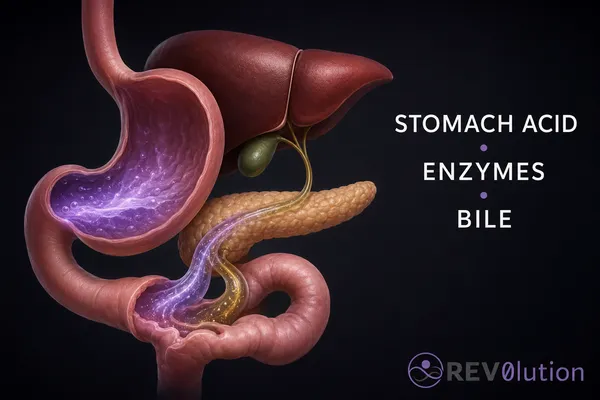
Stomach Acid, Digestive Enzymes, and Bile: How Digestion Works
What Do Stomach Acid, Digestive Enzymes, and Bile Actually Do?
Written by Kerri Rachelle, PhD(c), RDN, CSSD, FMP-AC
Founder & CEO, REV0lution | Doctor of Integrative & Natural Medicine Candidate
Quick Answer
Stomach acid prepares protein for digestion and activates pepsin. Digestive enzymes break protein, carbohydrate and fat into absorbable components, while bile helps disperse and absorb dietary fat.
Key Takeaways
Stomach acid, enzymes and bile perform different but coordinated jobs.
Digestive enzymes come from several organs—not only the pancreas.
Bile is produced by the liver; the gallbladder stores and concentrates it.
Bloating, reflux or heaviness cannot identify which digestive process is impaired.
Supplemental acid, enzymes and bile should not be used as substitutes for an appropriate evaluation.
What Does Stomach Acid Do?
The stomach produces hydrochloric acid, creating the acidic environment needed for the early stages of digestion.
Acid changes the structure of dietary protein and converts pepsinogen into pepsin, an enzyme that begins breaking protein into smaller peptides. Mechanical mixing then turns the meal into a semiliquid mixture called chyme.
Stomach acid also helps release certain nutrients from food and supports the absorption process for iron, calcium and vitamin B12. It provides a defense against many microorganisms swallowed with food, although it does not sterilize everything that enters the stomach.
The stomach protects itself from its own acidic contents through mucus, bicarbonate, tight cellular connections and adequate blood flow. Symptoms can develop when this protective system is injured or when acidic contents enter tissue that is not designed to tolerate them, such as the esophagus.
Does Stomach Acid Digest the Entire Meal?
No. Stomach acid is important, but it does not complete digestion by itself.
Protein digestion begins in the stomach and continues in the small intestine through pancreatic proteases and intestinal enzymes. Some fat digestion begins through gastric lipase, but most occurs later. Carbohydrate digestion begins in the mouth, pauses in the highly acidic stomach and resumes in the small intestine.
The digestive system works as a sequence. Acid, enzymes, bile, bicarbonate, motility and the intestinal surface must arrive and function in coordination.
Is Reflux a Sign of Too Much or Too Little Stomach Acid?
Reflux occurs when stomach contents move into the esophagus. Because the esophageal lining is not designed for repeated acid exposure, even a normal amount of stomach acid can cause burning or injury when it reaches the wrong location.
Online claims frequently present reflux as proof of low stomach acid. That conclusion cannot be made from symptoms. Reflux may involve lower-esophageal sphincter function, anatomical factors, meal size, stomach pressure, delayed emptying, medication or other contributors.
Low stomach acid is possible, and excessive or poorly controlled acid exposure is also possible. Neither should be diagnosed from reflux alone.
What Causes Low Stomach Acid?
Hypochlorhydria means reduced gastric-acid production. Achlorhydria refers to a near absence of acid.
Possible contributors include autoimmune gastritis, loss or damage of acid-producing parietal cells, certain patterns of Helicobacter pylori infection, gastric surgery and acid-suppressing medications.
The relationship between H. pylori and stomach acid is not identical in every person. Depending on where the inflammation occurs and how the condition progresses, H. pylori may be associated with reduced acid production or increased acid exposure. A positive result therefore does not automatically prove hypochlorhydria.
Autoimmune gastritis deserves particular attention because damage to parietal cells can affect both acid production and intrinsic factor. Iron deficiency may appear before vitamin B12 deficiency or pernicious anemia becomes obvious. Unexplained or recurrent iron or vitamin B12 deficiency—especially alongside autoimmune thyroid disease or persistent upper-digestive symptoms—may warrant further evaluation.
Age may influence gastric physiology, but low acid should not be treated as an inevitable consequence of getting older. An underlying condition may explain the change.
Symptoms attributed to low acid—bloating, belching, reflux, nausea and fullness—overlap with numerous other gastrointestinal conditions. Home baking-soda challenges and other social-media tests do not reliably diagnose hypochlorhydria.
Can a PPI Make Low Stomach Acid Worse?
Proton-pump inhibitors, or PPIs, intentionally suppress stomach-acid production. That effect can protect the esophagus, support ulcer healing and reduce complications when acid exposure is causing or worsening tissue injury.
However, heartburn does not necessarily mean that the stomach is producing excessive acid. Reflux describes stomach contents reaching the esophagus, where even a normal—or potentially reduced—amount of acid can cause symptoms. A person may therefore have reflux alongside reduced gastric-acid production.
This distinction becomes important when a PPI is prescribed from symptoms alone and then continued indefinitely without reassessing why it is needed. If someone also has autoimmune gastritis, damaged acid-producing cells, previous gastric surgery or another cause of hypochlorhydria, additional acid suppression may further reduce an already-low-acid environment.
Long-term acid suppression may influence vitamin B12, iron and magnesium status in susceptible people and can alter the gastrointestinal microbial environment. These possibilities do not mean that every person taking a PPI will develop a deficiency, SIBO or another complication. They mean that the indication, dose, duration, symptoms and relevant nutritional markers deserve periodic review.
PPIs should not be abruptly stopped because of something read online. Discontinuation after extended use may produce temporary rebound acid secretion, which can make symptoms flare and appear to confirm that the medication is permanently necessary. A prescribing clinician can determine whether the medication remains indicated and whether reassessment or supervised deprescribing is appropriate. The AGA deprescribing guidance emphasizes reviewing the indication and weighing benefits and risks rather than discontinuing a PPI solely out of concern about possible adverse effects.
Why Does the PPI Box Say to Use It for Only 14 Days?
Over-the-counter omeprazole and similar PPIs are labeled for one 14-day course. Current FDA guidance says OTC courses may generally be repeated up to three times per year unless a clinician directs otherwise. The omeprazole label specifically states not to use the medication for more than 14 days or more often than every four months unless directed by a doctor.
That warning does not mean the medication becomes toxic on day 15. It means persistent or repeatedly recurring symptoms should not be indefinitely self-treated without determining why they are occurring.
Prescription PPIs may appropriately be used for longer periods—and sometimes indefinitely—for conditions such as:
Severe erosive esophagitis
Barrett’s esophagus
Previous esophageal ulcer or peptic stricture
Recurrent or high-risk gastrointestinal bleeding
Continued use of ulcer-producing medication in someone at high bleeding risk
Certain hypersecretory conditions, such as Zollinger–Ellison syndrome
Those are different circumstances from continuing a PPI forever because someone once reported heartburn.
The real problem is that a short therapeutic trial can quietly become a permanent prescription. A PPI may be started during a hospitalization, prescribed empirically without confirmed GERD or repeatedly renewed after the original indication has resolved. No one reassesses whether the person still needs it, whether the lowest effective dose is being used or whether reflux is even the cause of the continuing symptoms.
Rebound acid secretion can further complicate the situation. When someone stops a PPI after extended use, temporary worsening of heartburn may occur. That flare may be interpreted as proof that the medication is still permanently necessary—even when it partly reflects the stomach readjusting after prolonged suppression.
This is where REV0lution takes a firm but responsible position: a PPI should not be demonized when it protects someone from a documented complication, but it should not remain on autopilot. Every long-term prescription should have a documented reason, an appropriate dose and a plan for periodic review.
The AGA deprescribing guidance recommends routinely reviewing the indication for every person taking a PPI. Patients without a clear indication for continued use should be considered for supervised deprescribing, while those with complicated GERD, Barrett’s esophagus or a high risk of gastrointestinal bleeding generally should not discontinue treatment without specialist guidance.
How Can You Tell Whether Stomach Acid Is High or Low?
Symptoms cannot reliably make that distinction. Reflux, belching, bloating, nausea, burning and post-meal fullness may occur with low acid, normal acid production, acid reflux, nonacid reflux, gastritis, functional dyspepsia or altered motility.
Popular home tests are not reliable diagnostic tools:
The baking-soda “burp test” has no validated timing cutoff that diagnoses low stomach acid.
Feeling better or worse after apple-cider vinegar does not measure gastric-acid production.
A betaine-hydrochloride challenge is not a validated diagnostic test. Producing warmth or burning does not prove that acid levels were previously adequate, and the product may aggravate gastritis, ulcers or esophageal irritation.
Antacid or PPI relief does not prove that the stomach was producing too much acid. Reducing the acidity of refluxed material can relieve symptoms regardless of total gastric-acid output.
Clinical evaluation depends on the question being asked. Upper endoscopy can identify esophagitis, ulcers, gastritis and anatomical findings. Ambulatory pH or pH-impedance monitoring measures acid and nonacid reflux reaching the esophagus; it does not directly measure how much acid the stomach can produce. Current reflux guidance uses objective monitoring when the diagnosis remains uncertain or symptoms persist despite treatment. AGA guidance and the Lyon Consensus 2.0 explain this distinction.
When hypochlorhydria or autoimmune gastritis is suspected, evaluation may include a complete blood count, iron and ferritin, vitamin B12, gastrin, pepsinogen, parietal-cell or intrinsic-factor antibodies, H. pylori testing and endoscopy with biopsy when clinically appropriate. Direct gastric-pH testing exists but is not routinely required for every person with reflux or bloating.
The useful question is not, “Should I add or remove acid based on a home experiment?” It is, “What is causing these symptoms, and which test would meaningfully distinguish among the possibilities?”
What Are Digestive Enzymes?
Digestive enzymes are proteins that accelerate the breakdown of food into components small enough to absorb.
Different enzymes work on different nutrients:
Proteases and peptidases break protein into peptides and amino acids.
Amylases and brush-border enzymes break digestible carbohydrate into simple sugars.
Lipases break triglycerides into fatty acids and monoglycerides.
Lactase breaks lactose into glucose and galactose.
These enzymes must encounter food at the appropriate time, location and pH. Digestion therefore depends on coordination as much as enzyme production.
Where Do Digestive Enzymes Come From?
Digestion begins before food reaches the stomach. Salivary glands release amylase, which begins carbohydrate digestion in the mouth.
The stomach produces pepsinogen and gastric lipase. Stomach acid activates pepsinogen into pepsin.
The pancreas supplies a large portion of the enzymes used in the small intestine, including pancreatic amylase, lipase, trypsin, chymotrypsin and other proteases. It also releases bicarbonate, which neutralizes acidic chyme entering from the stomach. This creates a safer environment for the small intestine and a more appropriate pH for pancreatic enzymes.
The small-intestinal lining supplies additional enzymes, including lactase, sucrase-isomaltase and peptidases. This is why someone can have difficulty digesting one specific carbohydrate without having broad pancreatic dysfunction.
What Is Pancreatic Exocrine Insufficiency?
Pancreatic exocrine insufficiency occurs when pancreatic enzyme activity is inadequate to maintain normal digestion.
It is more likely in people with chronic pancreatitis, cystic fibrosis, pancreatic cancer, pancreatic surgery and certain other conditions. Significant insufficiency can cause fat malabsorption, greasy or voluminous stool, diarrhea, weight loss and deficiencies of fat-soluble vitamins.
Bloating alone does not diagnose pancreatic insufficiency. When the clinical history raises concern, a clinician may consider stool testing, nutritional markers, imaging or other evaluation.
Prescription pancreatic-enzyme replacement therapy is a medical treatment for documented or strongly suspected insufficiency. It is different from casually adding an over-the-counter digestive-enzyme blend to every meal.
What Does Bile Do?
Bile is a fluid produced continuously by the liver. It contains bile acids, phospholipids, cholesterol, bilirubin, water and electrolytes.
The gallbladder stores and concentrates bile between meals. When fat enters the small intestine, hormonal signals encourage the gallbladder to contract and release bile.
Bile acids act somewhat like detergents. They disperse large fat droplets into smaller structures, increasing the surface area available to pancreatic lipase. They also help form micelles that carry fatty acids, cholesterol and fat-soluble vitamins toward the intestinal surface for absorption.
Most bile acids are later reabsorbed in the terminal ileum and returned to the liver. Gut microorganisms modify a portion of them, making bile part of the ongoing relationship between the liver, intestine and microbiome.
Is Bile a Digestive Enzyme?
No. Bile does not enzymatically cut fat molecules apart.
Bile emulsifies and solubilizes fat, making it more accessible. Pancreatic lipase performs much of the chemical breakdown.
This distinction matters because bile and pancreatic enzymes can both affect fat digestion while representing different physiological processes and different clinical problems.
What Happens After Gallbladder Removal?
The liver continues producing bile after the gallbladder is removed. What changes is the storage and concentrated release of bile with meals.
Many people digest food normally after gallbladder removal. Some experience temporary or persistent digestive changes, including diarrhea, urgency or difficulty tolerating especially large, high-fat meals.
Symptoms after gallbladder surgery do not automatically mean someone needs an ox-bile supplement. Diarrhea may involve excessive bile acids reaching the colon, which would require a different approach than presumed bile deficiency.
How Can Bile-Acid Problems Cause Diarrhea?
Most bile acids are reabsorbed before reaching the colon. If excessive bile acids enter the colon, they can stimulate water secretion and movement, causing watery diarrhea and urgency.
This may occur when the terminal ileum is diseased or has been surgically removed, after certain gastrointestinal procedures, or without an obvious structural cause.
Bile-acid diarrhea demonstrates why “supporting more bile flow” is not universally helpful. Someone may already have too much bile-acid activity in the colon.
How Are Stomach Acid, Bile, and Enzymes Connected With SIBO?
Stomach acid, intestinal motility, pancreatic secretions and bile help shape the environment of the small intestine. Disruption in one of these systems may change microbial conditions, but none is the sole cause of small intestinal bacterial overgrowth.
When SIBO is present, microorganisms may compete for nutrients, interfere with vitamin B12 availability and modify bile acids before they can perform their usual role in fat digestion. In more significant cases, that may contribute to fat malabsorption, diarrhea or nutritional deficiencies.
The relationship can therefore move in both directions: impaired digestive function or motility may increase susceptibility to overgrowth, while overgrowth may further interfere with digestion. Bloating alone cannot determine whether this cycle is present. SIBO requires its own clinical assessment, and treating presumed low acid or poor bile flow is not a substitute for identifying impaired motility, anatomical changes or other underlying contributors.
Do Greasy Stools Prove There Is a Bile or Enzyme Problem?
Greasy, pale, difficult-to-flush or unusually foul-smelling stool may raise concern about fat malabsorption, but it cannot identify the exact source.
Possible contributors include pancreatic exocrine insufficiency, reduced bile delivery, disease involving the small intestine, altered bile-acid circulation and other causes.
One unusual bowel movement after a rich meal is different from a persistent pattern accompanied by weight loss or nutritional deficiencies. Repeated symptoms deserve evaluation.
Can Symptoms Tell You Which Digestive Process Is Impaired?
Usually not.
Bloating after protein does not prove low stomach acid. Fullness after fat does not prove poor bile flow. Gas after carbohydrate does not prove pancreatic amylase insufficiency. Reflux does not establish that someone needs more acid.
Symptoms identify the experience. Clinical history, risk factors, examination and targeted testing help identify the mechanism.
This is particularly important because acid, enzyme and bile supplements are physiologically active. The fact that something is available without a prescription does not make it appropriate for every person with digestive discomfort.
How Are Acid, Enzyme, or Bile Problems Evaluated?
Evaluation depends on the suspected problem.
A clinician may consider testing for H. pylori, anemia, iron or vitamin B12 status when stomach disease is suspected. Autoimmune markers or endoscopy may be appropriate in specific situations.
Possible pancreatic insufficiency may be evaluated with stool elastase, fecal-fat assessment, nutritional markers or imaging, interpreted within the clinical context. Watery stool can dilute fecal elastase and potentially produce a misleadingly low result.
Bile-related concerns may require liver tests, imaging or evaluation for bile-acid diarrhea. No single comprehensive stool panel can fully assess every aspect of stomach, pancreatic and biliary function.
A GI-MAP may report H. pylori DNA, fecal pancreatic elastase-1 and steatocrit, but these markers must be interpreted according to what they actually measure. H. pylori DNA in stool does not measure stomach-acid production or establish the degree of gastritis. Pancreatic elastase is a useful indirect marker of pancreatic exocrine function, but a low result—particularly from watery stool—may require confirmation. Steatocrit indicates increased stool fat; it cannot determine whether the cause involves the pancreas, bile delivery, small-intestinal disease or another form of malabsorption. The current GI-MAP sample report confirms these are distinct markers rather than a complete measurement of digestive capacity.
Functional testing is most useful when a finding answers a defined clinical question and is integrated with symptoms, history, medication, nutrition, conventional laboratory testing and imaging when appropriate.
How Does the Nervous System Help Coordinate Digestion?
Digestive secretions are not released randomly. The sight, smell, taste and chewing of food begin neural signaling before the meal reaches the stomach. Once food enters the stomach and small intestine, stretching and nutrient exposure trigger additional nerve and hormonal signals that coordinate acid production, pancreatic bicarbonate and enzymes, gallbladder contraction and intestinal movement.
The vagus nerve participates in this communication, but it is inaccurate to claim that stress simply “turns digestion off.” Stress can alter motility, stomach accommodation, secretion and the perception of digestive sensations. That may make an existing problem feel worse without proving that acid, enzymes or bile are deficient.
Sitting down, chewing and allowing enough time to eat can support the normal digestive sequence. These habits are useful foundations, but they do not correct autoimmune gastritis, pancreatic insufficiency, gallbladder disease or another diagnosed disorder.
What Supports Normal Digestion?
Digestion benefits from adequate nourishment, appropriate meal portions, normal chewing and enough time to eat. Meals built from meaningful protein, plants, naturally occurring fats and individualized whole-food carbohydrates provide the raw materials the body needs.
Extremely restrictive diets can reduce symptoms temporarily simply because less food or less fermentable material is entering the system. That response does not necessarily reveal the underlying cause.
Avoid treating every digestive symptom with another capsule. If someone needs acid, enzymes or bile support for a diagnosed condition, the intervention should have a clear purpose and an appropriate monitoring plan.
What Is the Bottom Line?
Stomach acid, digestive enzymes and bile are different parts of one coordinated digestive process.
Stomach acid prepares protein and activates pepsin. Enzymes break nutrients into absorbable components. Bile helps pancreatic lipase access dietary fat and supports fat absorption.
Bloating, reflux, fullness and stool changes cannot determine which process is impaired. Respect the physiology, notice persistent patterns and use targeted evaluation before adding acid, enzymes, bile products or unnecessary food restrictions.
Frequently Asked Questions
What does stomach acid do to protein?
Stomach acid changes protein structure and activates pepsin, which begins breaking protein into smaller peptides. Protein digestion continues in the small intestine.
Does stomach acid digest carbohydrates?
Carbohydrate digestion begins with salivary amylase. It slows in the acidic stomach and resumes in the small intestine through pancreatic and brush-border enzymes.
Does reflux mean I have low stomach acid?
No. Reflux indicates that stomach contents are moving into the esophagus. Symptoms cannot determine whether gastric-acid production is low, normal or high.
What is the difference between bile and digestive enzymes?
Bile disperses fat and helps form structures needed for absorption. Digestive enzymes chemically break protein, carbohydrate and fat into smaller components.
Can you digest fat without a gallbladder?
Yes. The liver continues producing bile. The body loses the gallbladder’s ability to store, concentrate and release a larger amount of bile with a meal.
Does bloating mean I need digestive enzymes?
No. Bloating can involve meal size, constipation, motility, fermentation or digestive sensitivity. Enzyme insufficiency is only one possible explanation.
Can pancreatic insufficiency cause vitamin deficiencies?
Yes. Significant pancreatic insufficiency can impair fat digestion and contribute to deficiencies of vitamins A, D, E and K, along with weight loss and malnutrition.
Can low stomach acid or SIBO cause nutrient deficiencies?
They may contribute in the appropriate clinical context. Autoimmune gastritis can interfere with iron and vitamin B12 status, while significant SIBO may affect vitamin B12 availability, bile-acid function and fat absorption. A deficiency should be evaluated rather than automatically attributed to either condition.
Should everyone take digestive enzymes?
No. Enzymes may be appropriate for specific diagnosed conditions or clearly defined needs. They should not become an automatic response to every uncomfortable meal.
How do I know whether my bloating is caused by SIBO?
Symptoms cannot confirm SIBO because bloating, gas, diarrhea and constipation have many potential causes. Breath testing may be considered when the symptom pattern and risk factors make SIBO or intestinal methanogen overgrowth plausible, but results require careful interpretation. A stool microbiome test does not diagnose an overgrowth in the small intestine.
Can I test for low stomach acid at home?
No validated home test can reliably diagnose low stomach acid. Baking-soda, apple-cider-vinegar and betaine-HCl challenges do not measure gastric-acid production and may produce misleading or harmful results. Evaluation should be based on medical history, medication use, nutritional markers and targeted testing when warranted.
Why does the omeprazole box say 14 days if my doctor prescribed it long-term?
The 14-day label limits unsupervised OTC treatment. Some diagnosed conditions require longer-term acid suppression, but every long-term PPI prescription should have a clear indication and periodic review. It should not be continued indefinitely simply because no one has reassessed it.
Medical Disclaimer: This article is for general educational and informational purposes only and does not provide individualized medical or nutrition advice. It is not intended to diagnose, treat, cure, or prevent disease or replace care from a qualified healthcare professional. Do not change your medications, supplements, diet, fasting schedule, or healthcare plan based solely on this content. [Read the full Medical Disclaimer and Terms & Conditions.]
References
Pimentel M, Saad RJ, Long MD, Rao SSC. ACG Clinical Guideline: Small Intestinal Bacterial Overgrowth. Am J Gastroenterol. 2020;115(2):165–178. PMID: 32023228.
Baker JR, Rezaie A. Gas-tly Interpretations: A Case-Based Approach to the Nuances of SIBO Breath Testing. Curr Gastroenterol Rep. 2025. PMID: 40307658.
Losurdo G, Leandro G, Ierardi E, et al. Breath Tests for the Non-invasive Diagnosis of Small Intestinal Bacterial Overgrowth: A Systematic Review With Meta-analysis. J Neurogastroenterol Motil. 2020;26(1):16–28. PMID: 31743632.
Schubert ML. Functional Anatomy and Physiology of Gastric Secretion. Curr Opin Gastroenterol. 2015. PMID: 26376477.
Schubert ML. Physiologic, Pathophysiologic, and Pharmacologic Regulation of Gastric Acid Secretion. Curr Opin Gastroenterol. 2017;33(6):430–438. PMID: 28787289.
Borowitz D. Non-Pancreatic Digestive Enzymes. Biomolecules. 2025;15(9):1259. PMID: 41008568.
Nikfarjam M, Wilson JS, Smith RC. Diagnosis and Management of Pancreatic Exocrine Insufficiency. Med J Aust. 2017;207(4):161–165. PMID: 28814218.
Omer E, Chiodi C. Fat Digestion and Absorption: Normal Physiology and Pathophysiology of Malabsorption, Including Diagnostic Testing. Nutr Clin Pract. 2024;39 Suppl 1:S6–S16. PMID: 38429963.
Li T, Chiang JYL. Bile Acid Signaling in Metabolic and Inflammatory Diseases and Drug Development. Pharmacol Rev. 2024;76(6):1221–1253. PMID: 38977324.
Vavallo M, et al. Autoimmune Gastritis and Hypochlorhydria: Known Concepts From a New Perspective. Int J Mol Sci. 2024. PMID: 38999928.
Taylor L, et al. Creating a Framework for Treating Autoimmune Gastritis—The Case for Replacing Lost Acid. Nutrients. 2024. PMID: 38474790.