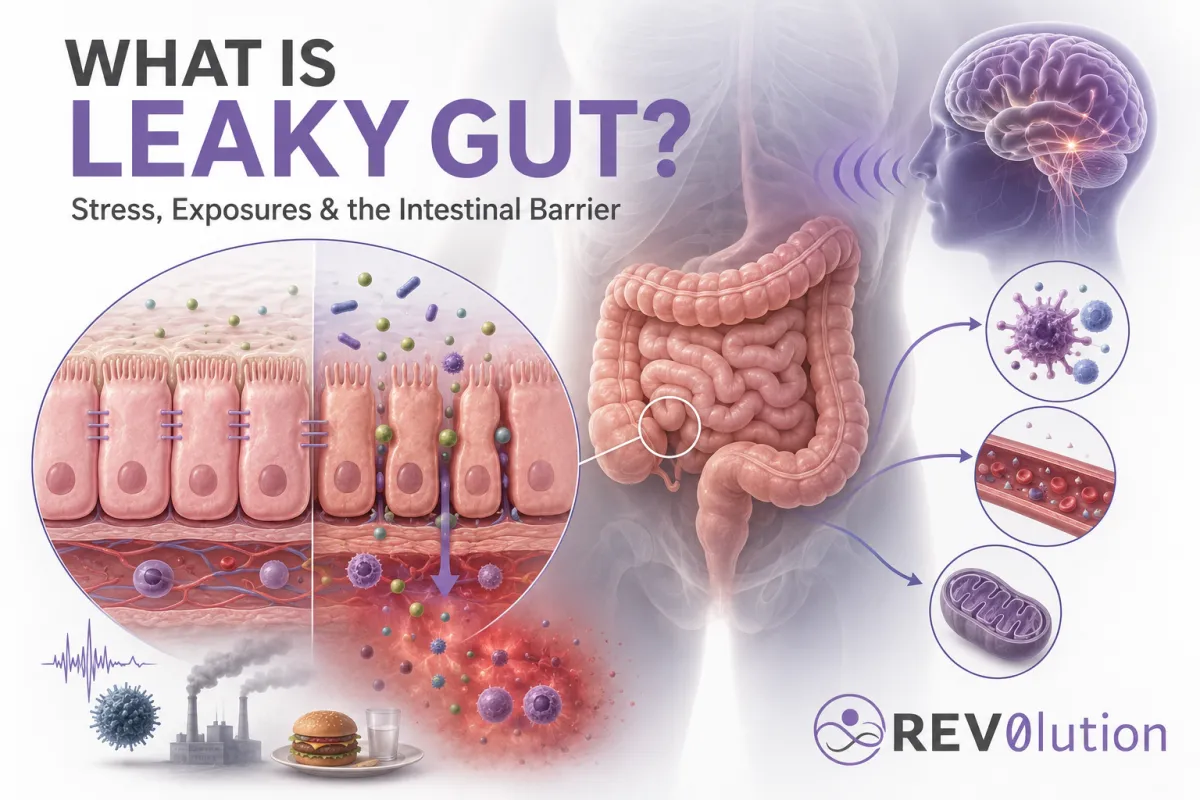
What Is Leaky Gut? Intestinal Permeability Explained
What Is Leaky Gut? How Stress, Toxins, and Inflammation Affect the Intestinal Barrier
Written by Kerri Rachelle, PhD(c), RDN, CSSD, FMP-AC
Founder & CEO,REV0lution | Doctor of Integrative & Natural Medicine Candidate
Quick Answer
“Leaky gut” refers to increased intestinal permeability—a change in how substances cross the intestinal barrier. That barrier includes an epithelial lining only one cell thick, supported by mucus, immune defenses, microbes and blood flow. Disease, inflammation, infection, stress signaling, alcohol, medications and environmental exposures may affect it, but symptoms alone cannot diagnose increased permeability or identify its cause.
Key Takeaways
The intestinal epithelium is only one cell thick, but it is supported by several overlapping defense systems.
The barrier must remain selectively permeable so nutrients, water and electrolytes can be absorbed.
Stress can influence permeability through HPA-axis, nervous-system, immune and mast-cell signaling.
Disease, infection, alcohol, medications, inadequate nourishment, strenuous exercise and environmental exposures may all affect barrier function.
Increased permeability is a physiological finding—not a complete diagnosis or proof of one universal root cause.
What Is the Intestinal Barrier?
The intestinal barrier is the boundary between the contents of the digestive tract and the tissues, immune system and circulation beyond it. Every day, this boundary encounters food, microorganisms, medications, alcohol, environmental compounds and microbial products.
At its core is the intestinal epithelium: a continuous lining composed largely of a single layer of cells. That means the physical distance separating the intestinal contents from the immune and circulatory systems beneath them may be only one cell thick.
This matters—but “one cell thick” should not be interpreted as defenseless. The epithelial layer is supported by mucus, tight junctions, antimicrobial compounds, secretory immunoglobulin A, immune cells, microbial communities, blood and lymphatic circulation, and continuous cellular renewal.
The gut barrier is therefore less like a solid wall and more like a highly regulated border. It must allow nutrients, water and electrolytes to cross while controlling contact with microorganisms, antigens and potentially harmful compounds.
What Does “Leaky Gut” Actually Mean?
“Leaky gut” is the popular term for increased intestinal permeability. It describes a change in how readily particular substances cross the intestinal lining.
Material can move through intestinal cells, between neighboring cells or through areas where the lining has been physically injured. These are not identical mechanisms, and they do not necessarily allow the same substances to pass.
The scientific concept is legitimate. The problem begins when “leaky gut” becomes a catchall diagnosis for fatigue, anxiety, weight gain, skin symptoms, food reactions, autoimmune disease and nearly every other chronic concern.
Increased permeability may be part of an illness without being its only cause. It may also develop as a consequence of inflammation, infection or another underlying condition. In many cases, the relationship can move in both directions.
How Does a One-Cell-Thick Gut Lining Control What Passes Through?
Proteins called tight junctions help regulate the spaces between adjacent epithelial cells. These junctions can become more open or closed in response to immune signals, microbial metabolites, nutrients, stress mediators and tissue injury.
Substances may also be transported directly through intestinal cells. Meanwhile, the mucus layer helps separate microbes from the epithelial surface, and immune cells beneath the lining constantly assess what crosses.
This is why reducing the intestinal barrier to “open” or “closed” is misleading. Barrier function differs throughout the gastrointestinal tract, changes over time and involves far more than one tight-junction protein.
How Can Stress Affect the Intestinal Barrier?
Stress is not merely an emotion. It produces measurable changes in nervous-system, hormonal, immune and gastrointestinal function.
When the brain perceives a threat, the hypothalamic-pituitary-adrenal axis—or HPA axis—helps organize the response. The hypothalamus releases corticotropin-releasing hormone, or CRH. CRH signals the pituitary gland to release ACTH, which then signals the adrenal glands to produce cortisol.
At the same time, the sympathetic-adrenal-medullary system increases sympathetic activity and releases stress mediators such as adrenaline and noradrenaline. The gastrointestinal tract also has local CRH signaling, an enteric nervous system and immune cells capable of responding to stress.
These pathways can influence:
Intestinal blood flow
Mucus production
Digestive secretions
Motility and transit time
Tight-junction regulation
Mast-cell activation
Immune signaling
Visceral sensitivity
Microbial behavior and habitat
Mast cells are especially relevant because they sit close to nerves and blood vessels beneath the intestinal epithelium. Stress-related CRH signaling may activate mast cells, which can release mediators that affect permeability, sensation and local immune activity.
Human experiments have found that acute psychological stress can increase intestinal or rectal permeability in some circumstances. The results are not identical across every population, type of stress or measurement method, but stress should not be dismissed as irrelevant simply because its effects are difficult to capture with one laboratory test.
Stress can also intensify digestive symptoms without producing permanent structural damage. It may alter motility, increase pain perception, worsen reflux, change bowel habits or make normal intestinal stretching feel uncomfortable.
This does not mean symptoms are “all in someone’s head.” It means the brain, nervous system, immune system and gastrointestinal tract are communicating exactly as they were designed to do—although that communication may become dysregulated.
Does HPA-Axis Dysfunction Mean Someone Has “Adrenal Fatigue”?
Not necessarily. The HPA axis is a real biological system, but the popular diagnosis of “adrenal fatigue” is not interchangeable with established adrenal disease or a specific permeability disorder.
Chronic stress may alter the timing and regulation of stress responses, but a single cortisol pattern cannot explain every case of fatigue, anxiety, digestive discomfort or impaired barrier function.
Fatigue still requires consideration of sleep, iron status, thyroid function, glucose regulation, medication, nutrition, infection, medical conditions and other possible contributors. HPA-axis physiology can be one part of the picture without becoming the explanation for everything.
Which Medical Conditions Can Increase Intestinal Permeability?
Barrier dysfunction has been observed in conditions including:
Celiac disease
Crohn’s disease and ulcerative colitis
Gastrointestinal infections
Critical illness
Severe intestinal inflammation
Direct injury to the gastrointestinal lining
In celiac disease, gluten exposure in a genetically susceptible person produces a specific immune response and intestinal injury. That established process should not be generalized into the claim that gluten damages everyone’s intestinal barrier.
Similarly, increased permeability in inflammatory bowel disease does not establish that a permeability problem independently caused the entire condition. Immune activity can damage the barrier, while barrier changes may further influence immune exposure.
Can Medications Affect the Gut Barrier?
Certain medications can influence the gastrointestinal lining, microbial ecosystem or permeability. Nonsteroidal anti-inflammatory drugs, or NSAIDs, are among the best-known examples. Chemotherapy and other treatments may also affect rapidly renewing intestinal cells.
This does not mean prescribed medications are “toxic” or should be stopped to protect the gut. A medication’s risks must be considered alongside the condition it treats, the dose, duration, alternatives and consequences of leaving the condition untreated.
No one should discontinue or alter prescribed medication based on an online leaky-gut theory.
Can Environmental Toxins Affect Intestinal Permeability?
The word “toxins” is used so loosely that it often becomes clinically meaningless. It helps to distinguish among microbial toxins, naturally occurring toxic substances and environmental toxicants such as certain pollutants, pesticides, heavy metals and persistent industrial chemicals.
The digestive tract is a major point of contact for substances entering through food and water. Research is examining how pesticides, air pollutants, heavy metals, PFAS, microplastics and nanoplastics may affect the microbiome, mucus, oxidative stress, immune signaling and epithelial integrity.
There are plausible mechanisms and concerning experimental findings. However, much of the direct barrier evidence still comes from cell and animal models, and the effects depend on the substance, amount, duration, route of exposure and person’s underlying health. Detecting a compound in the environment—or even in human tissue—does not prove that it caused one individual’s symptoms.
That uncertainty is not a reason to pretend exposure does not matter. REV0lution supports practical reduction of avoidable exposures when possible. It is reasonable to reduce unnecessary plastic contact with hot foods, avoid smoking, use appropriate ventilation, follow workplace protections, wash produce and pay attention to known local water or environmental concerns.
It is not reasonable to diagnose “toxin overload” from fatigue and bloating, order poorly validated panels and prescribe an expensive collection of binders or detoxification supplements without identifying a meaningful exposure.
Exposure reduction and responsible public-health protections matter. Fear-based detoxification protocols are not an equivalent substitute.
How Do Alcohol and Diet Affect the Gut Barrier?
Alcohol can disrupt epithelial integrity, affect tight junctions and alter microbial and immune signaling. The effect depends on the amount, frequency, pattern of use and the person’s health, but alcohol should not be marketed as neutral to gut function merely because some beverages contain polyphenols.
Diet also shapes the material presented to the intestinal surface and the microbes living within it. Adequate energy, meaningful protein, tolerated fiber, micronutrients and whole-food carbohydrates help support cellular renewal, mucus production and microbial metabolism.
Dietary fiber can be fermented into short-chain fatty acids such as butyrate, which help support colon cells and barrier function. More fiber is not automatically better for every symptomatic person, however. Someone experiencing active inflammation, impaired motility, significant bloating or a gastrointestinal disorder may require individualized amounts and types.
A dietary pattern dominated by ultra-processed products may provide less fiber and fewer protective nutrients while increasing exposure to refined ingredients and numerous additives. Human research on individual emulsifiers and barrier function is still developing, but REV0lution does not recommend building health on artificially sweetened drinks, packaged keto desserts, manufactured meal replacements or heavily formulated snack products.
The answer is not a universal elimination diet. It is a nourishing, minimally processed foundation adjusted to the person’s tolerance and medical needs.
Can Poor Sleep Affect Intestinal Permeability?
Sleep and circadian rhythms influence immune activity, appetite, microbial rhythms and gastrointestinal function. Animal studies frequently find barrier disruption with substantial sleep deprivation, but human findings are less consistent.
For example, a controlled study in healthy young men found that three nights of severe sleep restriction reduced microbial richness but did not measurably increase intestinal permeability. That does not prove sleep is irrelevant; it shows that one short exposure in one small population did not alter one set of permeability measurements.
Sleep remains foundational because it influences stress regulation, inflammation, food choices, glucose regulation and symptom perception—even when a permeability test does not change.
Can Strenuous Exercise Increase Intestinal Permeability?
Demanding endurance exercise can temporarily reduce intestinal blood flow and increase heat stress, mechanical stress and permeability. The risk becomes more relevant during prolonged or high-intensity activity, especially in hot conditions, with dehydration, inadequate fueling or NSAID use.
This does not make exercise harmful to the gut. Regular appropriately dosed movement generally supports health. The concern is a mismatch among the training demand, environmental conditions, hydration, fueling and recovery.
Athletes experiencing recurrent nausea, diarrhea, cramping or an urgent need to defecate during training deserve a sports-nutrition and medical evaluation—not advice to train harder through it.
Is Leaky Gut Connected to Autoimmune Disease?
Intestinal-barrier dysfunction has been studied in celiac disease, inflammatory bowel disease and other immune-mediated conditions. Because the intestinal lining helps regulate contact between the external environment and the immune system, barrier changes may influence immune exposure and signaling.
That does not establish increased permeability as the solitary cause of every autoimmune disease. Genetics, infections, hormones, environmental exposures, immune regulation and other factors may contribute.
Permeability can be a contributor, a consequence or both. “Seal the gut and reverse autoimmunity” is not an adequately supported universal treatment claim.
Is Leaky Gut Connected to Insulin Resistance?
Research has identified relationships among barrier function, microbial products, inflammation, adipose tissue and impaired glucose regulation. This has contributed to interest in metabolic endotoxemia, in which microbial components such as lipopolysaccharide may enter circulation in greater amounts and influence immune signaling.
The human metabolic picture remains more complex than the simplified claim that leaky gut causes insulin resistance. Sleep, muscle mass, physical activity, liver health, food quality, energy balance, medications, genetics and body-fat distribution can affect glucose and insulin regulation.
Intestinal permeability may be one part of metabolic dysfunction, but it does not replace the need to assess fasting insulin, glucose regulation, nutrition, sleep, movement and other established factors.
Can Symptoms Diagnose Leaky Gut?
No symptom is exclusive to increased intestinal permeability.
Bloating, abdominal pain, constipation, diarrhea and food-related symptoms can occur in conditions that may or may not involve barrier dysfunction. Fatigue, headaches, skin concerns, anxiety and brain fog are even less specific.
A person with fatigue and bloating might have iron deficiency, celiac disease, thyroid dysfunction, a gastrointestinal infection, inadequate intake, medication effects, poor sleep, a disorder of gut-brain interaction, impaired motility or several overlapping concerns.
Symptoms deserve investigation. They do not establish the mechanism.
How Is Intestinal Permeability Measured?
Research methods often use orally consumed probe molecules and then measure how much appears in urine or blood. Different probes examine different regions and pathways. Specialized tissue samples may also be assessed directly.
Blood and stool markers can provide indirect information about intestinal injury, immune activity or microbial exposure, but they do not all measure the same process.
Results may be affected by:
The marker and method used
The intestinal region examined
Collection timing
Kidney function
Recent food, medication or alcohol exposure
Exercise
Infection or active inflammation
Laboratory methodology
No single commercially available test captures the entire intestinal barrier.
Can a Zonulin Test Diagnose Leaky Gut?
Zonulin has been investigated because it participates in tight-junction regulation. Commercial serum and stool zonulin tests are often marketed as direct proof of leaky gut.
Interpretation is not that simple.
A widely cited analysis found that a commonly used commercial zonulin assay did not detect pre-haptoglobin 2, the protein originally identified as zonulin, and may have detected other related proteins. If the assay target is uncertain, a numerical result cannot independently establish a diagnosis.
A zonulin result should not, by itself, trigger an extreme elimination diet, supplement protocol or diagnosis of systemic illness.
Does Finding Increased Permeability Reveal the Root Cause?
No. Increased permeability describes what the barrier is doing—not necessarily why it changed.
Potential influences include:
Active gastrointestinal disease
Infection
Inflammation
Medication exposure
Alcohol
Psychological or physiological stress
Reduced intestinal blood flow
Inadequate nourishment
Extreme exercise
Environmental toxicant exposure
Several interacting factors
Calling increased permeability “the root cause” without investigating what disrupted the barrier simply moves the label backward by one step.
Can a Gut-Repair Protocol Fix Leaky Gut?
There is no universal gut-repair protocol appropriate for every person.
Online protocols commonly combine restrictive diets, powders, probiotics, glutamine, herbs and binders without establishing why the barrier may be affected. That can become expensive, nutritionally limiting and physiologically stressful.
Celiac disease, inflammatory bowel disease, infection, medication-related injury, chronic under-fueling, extreme training, significant stress and disorders of gut-brain interaction require different care.
A supplement cannot compensate for untreated disease, inadequate nourishment, persistent alcohol exposure, unprotected sleep, overwhelming stress or a diet dominated by manufactured substitutes.
Care should begin by identifying the underlying problem, ensuring adequate nutrition, addressing bowel function and sleep, reviewing medications and exposures, and determining which interventions are actually necessary.
When Should Digestive Symptoms Be Medically Evaluated?
Seek medical evaluation for persistent or severe abdominal pain, repeated vomiting, blood in the stool, black stool, unexplained weight loss, anemia, fever, difficulty swallowing, persistent diarrhea, nighttime symptoms or a significant change in bowel habits.
Recurring symptoms also deserve attention when they interfere with eating, sleep, work, exercise or everyday life.
Evaluation may include a detailed history, medication and supplement review, nutrition assessment, conventional bloodwork, stool testing, imaging, endoscopy or other testing based on the clinical picture. The purpose is to identify what requires care—not merely confirm a popular label.
What Is the Bottom Line on Leaky Gut?
The intestinal epithelium may be only one cell thick, but it operates within an intricate protective system involving mucus, immune defenses, microbes, circulation and constant communication with the brain.
Increased intestinal permeability is real. Disease, inflammation, infection, stress signaling, alcohol, medication, intense exercise, inadequate nourishment and environmental exposures may all influence it.
That does not make “leaky gut syndrome” a sufficient explanation for every chronic symptom. A thoughtful approach asks what affected the barrier, what else may be contributing and whether the finding changes care.
The goal is not to chase a leak with restrictive diets, binders and endless supplements. It is to understand the person, investigate meaningful causes and rebuild the foundations that allow the intestinal barrier—and the whole body—to function well.
Medical Disclaimer: This article is for general educational and informational purposes only and does not provide individualized medical or nutrition advice. It is not intended to diagnose, treat, cure, or prevent disease or replace care from a qualified healthcare professional. Do not change your medications, supplements, diet, fasting schedule, or healthcare plan based solely on this content. [Read the full Medical Disclaimer and Terms & Conditions.]
Frequently Asked Questions
Is leaky gut real?
Increased intestinal permeability is a real physiological change. “Leaky gut syndrome,” as broadly promoted online, is not a standardized diagnosis that explains every chronic symptom.
Is the intestinal lining really only one cell thick?
The intestinal epithelium is primarily a single layer of cells. It is supported by mucus, tight junctions, immune defenses, microbes, connective tissue, circulation and rapid cellular renewal.
Can stress cause leaky gut?
Stress signaling can influence permeability through the HPA axis, sympathetic nervous system, CRH, mast cells, blood flow and immune activity. Human responses vary, so stress should be considered a possible contributor rather than assumed to be the only cause.
What does the HPA axis have to do with gut health?
The HPA axis coordinates part of the body’s stress response. Its signals can affect cortisol, immune activity, motility, secretion, sensitivity and intestinal-barrier regulation.
Can environmental toxins damage the intestinal barrier?
Certain pollutants, pesticides, heavy metals and microplastics can affect barrier-related pathways in experimental research. Human evidence is still developing and depends on the specific exposure. Reducing avoidable exposure is reasonable, but symptoms alone cannot prove toxicant-induced barrier damage.
Does gluten cause leaky gut in everyone?
No. Gluten causes defined immune-mediated intestinal injury in people with celiac disease. That should not be generalized to every person.
Can a zonulin test prove that I have leaky gut?
No. Commercial zonulin assays have important analytical and interpretation limitations and should not independently determine a diagnosis or treatment plan.
Do probiotics repair leaky gut?
Effects depend on the strain, condition, person and outcome measured. No unspecified probiotic has been shown to repair every form of increased permeability.
References
Camilleri M. Leaky Gut: Mechanisms, Measurement and Clinical Implications in Humans. Gut. 2019;68(8):1516–1526. PMID: 31076401.
Saha K, Zhou Y, Turner JR. Tight Junction Regulation, Intestinal Permeability, and Mucosal Immunity in Gastrointestinal Health and Disease. Curr Opin Gastroenterol. 2025;41(1):46–53. PMID: 39560621.
Vanuytsel T, van Wanrooy S, Vanheel H, et al. Psychological Stress and Corticotropin-Releasing Hormone Increase Intestinal Permeability in Humans by a Mast Cell-Dependent Mechanism. Gut. 2014;63(8):1293–1299. PMID: 24153250.
Gerdin L, et al. Acute Psychological Stress Increases Paracellular Permeability and Modulates Immune Activity in Rectal Mucosa of Healthy Volunteers. United European Gastroenterol J. 2023;11(1):31–41. PMID: 36314901.
de Punder K, Pruimboom L. Psychosocial Stress-Induced Intestinal Permeability in Healthy Humans: What Is the Evidence? Clin Exp Gastroenterol. 2023. PMID: 37842017.
König J, Wells J, Cani PD, et al. Human Intestinal Barrier Function in Health and Disease. Clin Transl Gastroenterol. 2016;7(10):e196. PMID: 27763627.
Meyer F, et al. Cytokines and Intestinal Epithelial Permeability: A Systematic Review. Autoimmun Rev. 2023;22(6):103331. PMID: 37030338.
Scheffler L, Crane A, Heyne H, et al. Widely Used Commercial ELISA Does Not Detect Precursor of Haptoglobin 2, but Recognizes Properdin as a Potential Second Member of the Zonulin Family. Front Endocrinol. 2018;9:22. PMID: 29459849.
Karl JP, et al. Severe, Short-Term Sleep Restriction Reduces Gut Microbiota Community Richness but Does Not Alter Intestinal Permeability in Healthy Young Men. Sci Rep. 2023;13:251. PMID: 36604516.
Krode K, et al. Effect of Five Dietary Emulsifiers on Inflammation, Permeability, and the Gut Microbiome: A Placebo-Controlled Randomized Trial. Gastroenterology. 2026. PMID: 40816342.
Chartres N, et al. Effects of Microplastic Exposure on Human Digestive, Reproductive, and Respiratory Health: A Rapid Systematic Review. Environ Sci Technol. 2024. PMID: 39692326.
Bischoff SC, Barbara G, Buurman W, et al. Intestinal Permeability—A New Target for Disease Prevention and Therapy. BMC Gastroenterol. 2014;14:189. PMID: 25407511.