
podcast
Beyond the biomarkers

want More?
Download the free 2-Week Energetic Reset Guide, created to help you put podcast insights into practice with actionable nutrition, lifestyle, and gut health strategies you can start today.
What to expect:
14-Day Nutrition Plan
Recipe Book
Gut Health Hacks
Nutrition Tips
Fitness Routines
Dedicated Community
Follow on:
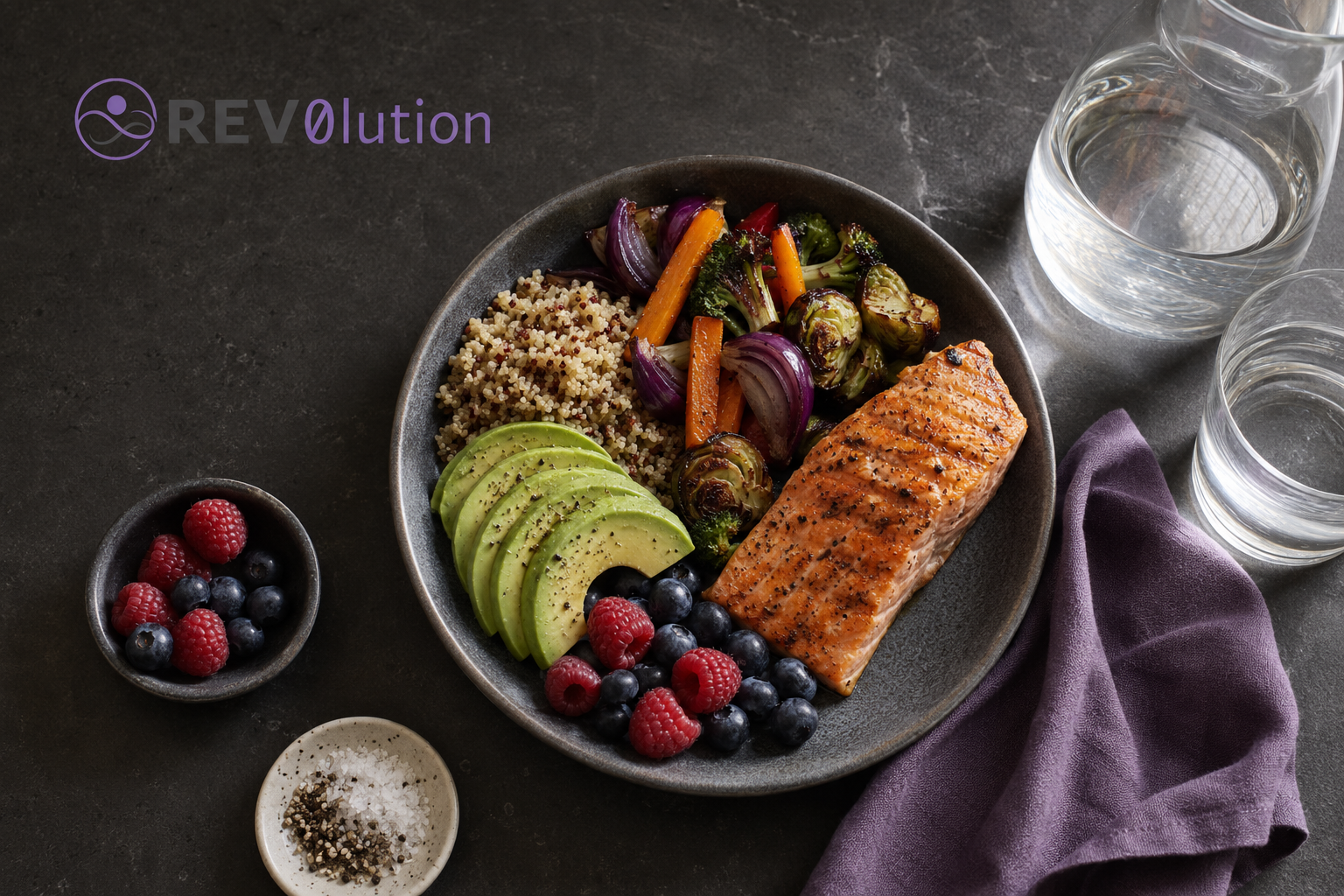
What Is Clean Eating? A Practical Real-Food Approach
Real-Food Nutrition: The REV0lution Approach
Written by Kerri Rachelle, PhD(c), RDN, CSSD, FMP-AC
Founder & CEO, REV0lution | Doctor of Integrative & Natural Medicine Candidate
Real Food. Meaningful Nourishment. Better Health.
Nutrition has become unnecessarily complicated. Foods are assigned moral labels, diet trends contradict one another and packaged products are promoted as solutions to problems they may help perpetuate.
The REV0lution approach begins with something simpler: build most meals from recognizable, minimally processed foods that provide meaningful nourishment.
Real-food nutrition is not about perfection, punishment or earning your meals. It is about consistently choosing foods that support energy, muscle, metabolism, digestion, recovery and long-term health.
What Does “Real Food” Mean?
Real food generally resembles the ingredients from which it came. It includes vegetables, fruit, eggs, fish, seafood, meat, poultry, legumes, nuts, seeds, minimally processed grains, fermented foods and naturally occurring fats.
Processing is not automatically harmful. Chopping vegetables, freezing berries, fermenting cabbage, making yogurt and canning fish are all forms of processing. These methods can improve convenience, preservation, safety or digestibility.
The greater concern is a dietary pattern dominated by ultra-processed products designed around refined starches, added sugars, manufactured flavors, artificial sweeteners, emulsifiers, colors and other additives. These products are often easy to consume quickly and may displace foods that provide more protein, fiber and micronutrients.
In a controlled NIH trial, participants ate approximately 500 more calories per day and gained weight while eating an ultra-processed diet compared with a minimally processed diet—even though the presented diets were matched for calories, macronutrients, sugar, sodium and fiber. The study was small and short, but it demonstrated that food structure and processing can influence how much people spontaneously consume. The NIH randomized trial supports prioritizing minimally processed foods without claiming that every packaged product has the same effect.
What Real-Food Nutrition Can Support
A thoughtfully constructed real-food pattern can provide:
Meaningful protein for muscle and recovery
Fiber for digestion, satiety and the intestinal environment
Vitamins and minerals needed throughout the body
Whole-food carbohydrates for energy and activity
Naturally occurring fats for essential fatty acids and nutrient absorption
Greater meal satisfaction and more stable energy
No individual food guarantees these outcomes. The overall pattern, portions, consistency and individual physiology still matter.
Food Is More Than a Calorie Total
Calories matter because the body must account for energy. But calorie content does not fully describe a food.
A piece of salmon and a packaged snack may contain the same number of calories while providing very different amounts of protein, essential fatty acids, minerals and satiety. Similarly, fruit and candy both contain carbohydrate, but their food structure and nutritional contributions are not equivalent.
Food provides energy, but it also provides amino acids, fatty acids, fiber, vitamins, minerals and thousands of biologically active compounds. That is why matching calories or macronutrients does not make two foods nutritionally interchangeable.
Refined Carbohydrates in Context
Sugar and refined flour are not literally devoid of all nutrients, particularly when flour has been fortified. However, foods built primarily from refined flour and added sugar generally provide less fiber and fewer naturally occurring nutrients than intact or minimally processed alternatives.
They are also easy to consume without much protein or lasting fullness. That can contribute to a pattern of short-lived energy, recurring hunger and repeated snacking for some people.
The goal is not to fear every food containing flour or sugar. It is to prevent refined products from becoming the foundation of the diet.
Choose fruit, root vegetables, beans, lentils, squash, oats, rice, quinoa and other tolerated whole-food carbohydrates more often. Use added sugar intentionally rather than allowing it to appear throughout the day in drinks, sauces, snacks and “health” products.
Eating Enough Is Part of Eating Well
Real-food nutrition is not another name for chronic restriction.
Waiting until you are intensely hungry can make decision-making more difficult, particularly if you have been under-eating, sleeping poorly or completing demanding exercise. Regular, adequately sized meals can support energy, appetite awareness and training recovery.
Many people feel good with three primary meals, while others benefit from an additional snack. Some naturally prefer fewer eating occasions. There is no universal meal frequency.
The appropriate schedule is the one that provides enough nourishment, fits your day and allows you to recognize hunger before it becomes an emergency.
A Simple Way to Build a Meal
Most meals can begin with four components:
Protein: eggs, fish, seafood, poultry, meat, Greek yogurt, cottage cheese, tofu, tempeh, beans or lentils in an appropriate combination
Plants: non-starchy vegetables, fruit, herbs, legumes, nuts or seeds
Whole-food carbohydrate: fruit, potatoes, beans, squash, rice, quinoa, oats or another tolerated source
Naturally occurring fat: olive oil, avocado, nuts, seeds, eggs or fatty fish
The amounts should change according to body size, activity, health, appetite and goals. The framework provides structure without requiring every person to follow the same meal plan.
What About Packaged Foods?
Convenience is not the enemy. Frozen vegetables, canned salmon, plain yogurt, prewashed greens and minimally formulated sauces can make real-food eating much more practical.
Read the ingredient list and ask:
Does this product provide something useful?
Are the ingredients recognizable?
Does it contain meaningful protein or fiber?
Is added sugar necessary?
Is it artificially sweetened?
Is the ingredient list built around food—or around a manufactured flavor system?
REV0lution does not recommend building health on artificially sweetened shakes, protein bars, packaged keto desserts or other manufactured substitutes. These products may match the macronutrients of a meal on paper, but that does not make them equivalent to real food.
The Bottom Line
Real-food nutrition does not require a perfect kitchen, a rigid identity or fear of every food you did not prepare yourself.
It means allowing recognizable, minimally processed foods to form the foundation of your diet. Begin with protein, add plants, include carbohydrates and fats that support your needs and eat enough to fuel the life you are asking your body to live.
Real food. Meaningful nourishment. Better health.
Medical Disclaimer: This article is for general educational and informational purposes only and does not provide individualized medical or nutrition advice. It is not intended to diagnose, treat, cure, or prevent disease or replace care from a qualified healthcare professional. Do not change your medications, supplements, diet, fasting schedule, or healthcare plan based solely on this content. [Read the full Medical Disclaimer and Terms & Conditions.]