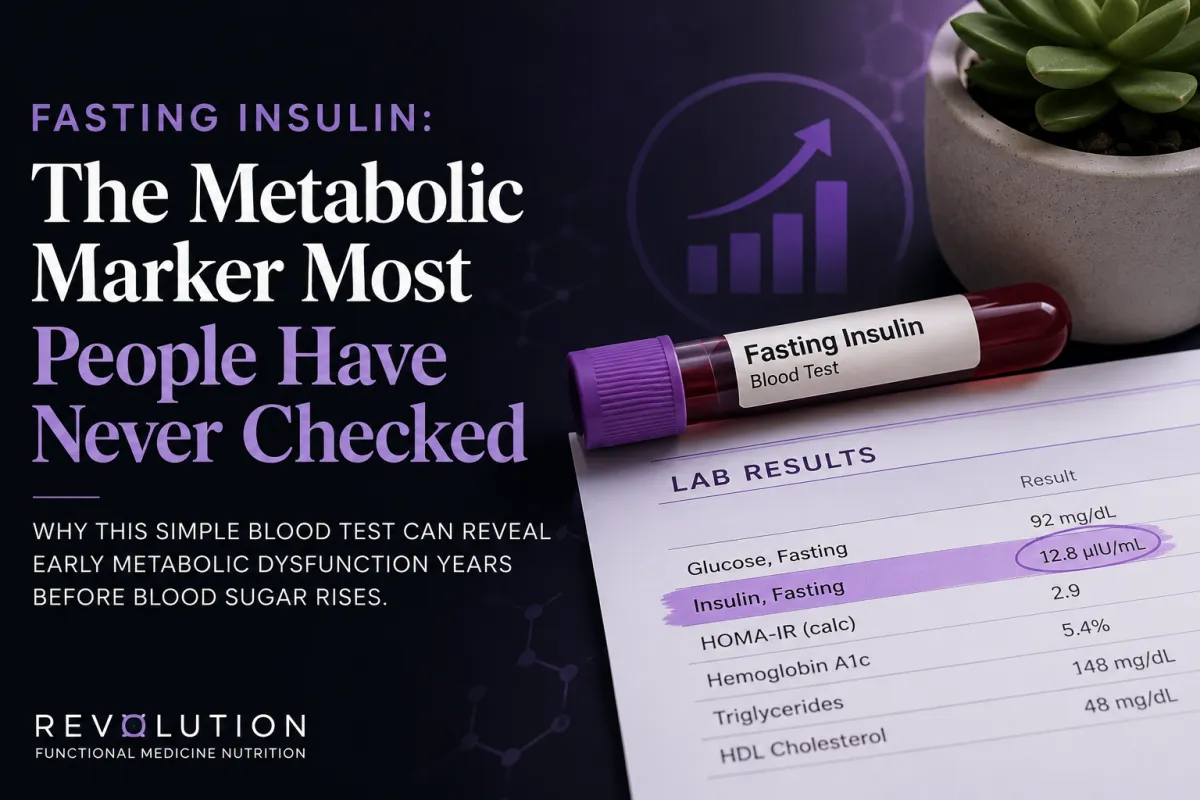
Fasting Insulin: The Metabolic Marker Most People Never Have Checked
Fasting Insulin: The Metabolic Marker Most People Have Never Checked
Written by Kerri Rachelle, PhD c., RDN, CSSD, FMP-AC
Quick Answer
Fasting insulin is a simple blood test that measures how much insulin your body is producing after an overnight fast. Unlike glucose or hemoglobin A1c, which tell us how much sugar is circulating in your blood, fasting insulin can provide insight into how hard your body is working to keep blood sugar there.
Because insulin resistance often develops years before blood sugar becomes abnormal, fasting insulin may identify early metabolic changes long before someone meets the criteria for prediabetes or type 2 diabetes. At REV0lution, we frequently include fasting insulin as part of a comprehensive metabolic evaluation because understanding what is happening beneath the surface creates opportunities to intervene earlier.
Key Takeaways
Fasting insulin often changes years before glucose or A1c become abnormal.
It helps evaluate how efficiently your body is responding to insulin rather than simply measuring blood sugar.
Elevated fasting insulin is often one of the earliest signs of declining metabolic health.
Fasting insulin is most valuable when interpreted alongside your symptoms, medical history, lifestyle, and other laboratory markers.
We view fasting insulin as an adaptation marker—not a failure marker.
Understanding metabolic health earlier creates more opportunities to prevent chronic disease rather than simply reacting to it.
Why Have Most People Never Had Their Fasting Insulin Checked?
One of the most common conversations we have during virtual appointments begins with a patient saying something like:
"My blood sugar is normal."
"My A1c looks great."
"My doctor said everything came back fine."
Yet they're struggling with stubborn weight gain, afternoon energy crashes, increased abdominal fat, carbohydrate cravings, fatty liver disease, or symptoms that simply don't match what their laboratory work appears to say.
In many of these situations, the missing piece isn't necessarily another diagnosis. Sometimes it's a laboratory marker that was never ordered in the first place.
Fasting insulin is still not included on most routine wellness blood panels. Conventional screening often focuses on identifying disease once blood sugar begins to rise. Fasting insulin gives us the opportunity to look much earlier in the metabolic timeline—when the body may already be adapting but before glucose and A1c reflect those changes.
That doesn't mean everyone needs every laboratory test available. At REV0lution, we believe testing should answer a meaningful clinical question. However, fasting insulin is inexpensive, easy to add to routine blood work, and often provides valuable information that complements traditional metabolic markers.
Glucose and A1c Tell Us Part of the Story
Most people are familiar with fasting glucose and hemoglobin A1c. Both are valuable laboratory markers, but they answer a different question than fasting insulin.
Glucose tells us how much sugar is circulating in the bloodstream at a specific moment. Hemoglobin A1c estimates average blood sugar over the previous two to three months. Both help us understand blood sugar control.
Fasting insulin helps us understand what your body had to do to keep those numbers there.
Imagine two people whose fasting glucose is 88 mg/dL. On paper, they appear identical. One person's pancreas may only need a small amount of insulin to maintain that healthy blood sugar, while the other person's pancreas may be producing two or three times as much insulin because their cells have become less responsive. Their glucose looks the same, but their metabolism is working very differently.
This is one reason fasting insulin has become an increasingly valuable marker in understanding metabolic health. It often provides context that glucose alone cannot.
Fasting Insulin Is an Adaptation Marker
Many people hear the words high insulin and immediately assume something is wrong.
We see it differently.
At REV0lution, we view fasting insulin as an adaptation marker.
Your body is remarkably intelligent. When cells begin responding less efficiently to insulin, the pancreas compensates by producing more. Its goal is simple: keep blood sugar within a healthy range for as long as possible.
In many ways, elevated fasting insulin represents your body's attempt to protect you.
This compensation can continue quietly for years—even a decade or more—before fasting glucose or hemoglobin A1c begin moving outside of normal ranges. During that time, however, higher insulin levels may already be influencing fat storage, energy regulation, hunger, triglycerides, liver health, reproductive hormones, and other aspects of metabolic function.
Rather than viewing elevated fasting insulin as a diagnosis itself, we see it as an invitation to ask a better question:
Why is the body working harder than it used to?
That shift in perspective changes the conversation from treating numbers to understanding physiology.
When Do We Check Fasting Insulin?
While fasting insulin can be a valuable baseline marker for many adults, we are especially likely to recommend it when someone presents with patterns that suggest metabolic dysfunction may already be developing.
Examples include resistant weight loss, increased abdominal fat, Polyendocrine Metabolic Ovarian Syndrome (PMOS), fatty liver disease, elevated triglycerides, prediabetes, metabolic syndrome, carbohydrate cravings, energy crashes after meals, hypertension, or a strong family history of type 2 diabetes.
We also pay close attention to situations where blood sugar markers may not tell the whole story. For example, iron deficiency anemia—particularly in women with heavy menstrual bleeding—can influence hemoglobin A1c because A1c depends on the lifespan of red blood cells. In these situations, fasting insulin may provide additional metabolic insight alongside other laboratory findings.
Sometimes we recommend fasting insulin for another simple reason:
Everyone deserves to understand their baseline metabolic health before disease develops.
What About HOMA-IR?
You may come across something called HOMA-IR, which stands for Homeostatic Model Assessment of Insulin Resistance. It isn't another laboratory test. Instead, it's a mathematical calculation that combines your fasting glucose and fasting insulin from the same blood draw to estimate how hard your body is working to maintain blood sugar balance.
For clinicians, HOMA-IR can provide additional context when evaluating insulin sensitivity. For patients, there is no need to calculate it yourself or memorize formulas. What matters most is understanding what your results mean for you.
At REV0lution, we interpret fasting insulin, glucose, HOMA-IR when appropriate, your symptoms, health history, medications, nutrition, movement, sleep, and other laboratory markers together. A single number is rarely the whole story. The goal is not simply to collect more data—it is to understand how your metabolism is functioning as a whole.
What Can Affect Your Fasting Insulin Results?
Like any laboratory test, fasting insulin is most helpful when it's measured under consistent conditions. Because insulin responds quickly to changes in food, activity, sleep, and stress, preparation matters.
For the most accurate results, fasting insulin is typically measured after an overnight fast of 8 to 12 hours, with water permitted. We generally recommend scheduling the blood draw in the morning, avoiding intense exercise the day before, and maintaining your usual routine rather than trying to "be extra healthy" for a few days beforehand. A poor night's sleep, acute illness, certain medications, and even significant life stress can temporarily influence insulin levels, which is why we always interpret laboratory results alongside what was happening in your life at the time of testing.
One of the most important recommendations we make is consistency. If you're tracking your progress over time, try to use the same laboratory whenever possible. Different laboratories use different testing methods, and small differences between assays can make trend interpretation more difficult.
Could Your A1c Be Misleading?
Hemoglobin A1c is an excellent test in many situations, but like every laboratory marker, it has limitations.
A1c estimates your average blood sugar by measuring glucose attached to red blood cells. Because red blood cells normally live about 120 days, anything that changes their lifespan can influence the result.
Iron deficiency anemia is one example. Someone with low iron—particularly women with heavy menstrual bleeding—may have an A1c that appears higher than their actual blood sugar patterns would suggest. Pregnancy, the postpartum period, certain blood disorders, recent blood loss, or conditions that affect red blood cell turnover may also influence interpretation.
This doesn't make A1c a "bad" test. It simply reminds us that no laboratory value should ever be interpreted in isolation. Looking at fasting glucose, fasting insulin, symptoms, iron studies, and the broader clinical picture often provides a much more accurate understanding of metabolic health.
Common Mistakes We See
One of the biggest mistakes in healthcare is waiting until fasting glucose or hemoglobin A1c become abnormal before asking whether metabolism has been struggling for years.
By the time someone is diagnosed with prediabetes or type 2 diabetes, the underlying metabolic process has often been developing quietly for a long time. Fasting insulin gives us an opportunity to recognize that process much earlier.
We also see fasting insulin interpreted without adequate context. Looking only at the laboratory reference range may miss early metabolic changes because standard reference ranges are based on population averages—not necessarily optimal health. As the prevalence of metabolic disease has increased, what is considered "normal" has shifted alongside the health of the population.
Another common mistake is interpreting fasting insulin without also reviewing fasting glucose, triglycerides, HDL cholesterol, liver enzymes, waist circumference, body composition, symptoms, sleep, stress, medications, nutrition, and physical activity. Metabolism is complex, and no single laboratory marker can tell the entire story.
Finally, we caution against treating elevated fasting insulin as the diagnosis itself. Elevated insulin is usually an adaptation—a signal that the body is compensating. The more valuable question is why that adaptation is occurring.
How Often Should Fasting Insulin Be Rechecked?
The answer depends entirely on your starting point.
If your fasting insulin falls within an optimal range and your overall metabolic health is stable, repeating it annually as part of routine wellness laboratory testing is often appropriate.
If your fasting insulin is elevated and you're actively working on nutrition, exercise, sleep, stress management, or other lifestyle changes, repeating the test approximately every three to four months often provides enough time to see meaningful physiological improvements. This timeframe reflects real metabolic adaptation rather than normal day-to-day variation.
Once insulin levels begin improving and become more stable, many people transition to checking them every six to twelve months depending on their overall health, medical conditions, insurance coverage, and goals.
Our goal isn't to chase laboratory numbers. It's to measure whether the changes you're making are actually improving your metabolic health.
What If Your Fasting Insulin Is Elevated?
An elevated fasting insulin level is not a reason to panic.
It also isn't a reason to immediately eliminate every carbohydrate, purchase a long list of supplements, or begin following the latest diet trending on social media.
Instead, we ask why your body is asking for more insulin in the first place.
For some people, the answer may involve nutrition quality or eating patterns. For others, it may relate to inadequate muscle mass, prolonged sitting, poor sleep, chronic stress, environmental exposures, medications, hormonal conditions such as Polyendocrine Metabolic Ovarian Syndrome (PMOS), fatty liver disease, genetics, or several contributing factors occurring together.
Because metabolism is highly individualized, treatment should be too. There is no single nutrition plan, supplement, exercise program, or fasting schedule that works for everyone. Recommendations should reflect your laboratory findings, medical history, medications, lifestyle, body composition, goals, and what is both safe and sustainable for you.
At REV0lution, we believe meaningful progress happens when recommendations fit the individual—not when individuals are forced to fit a protocol.
Our Philosophy
We don't order fasting insulin simply because it's available. We order it because we believe people deserve the opportunity to understand their metabolic health before chronic disease develops. Laboratory testing should never create fear. It should create clarity.
Fasting insulin is one piece of a much larger picture that includes your nutrition, movement, sleep, stress, environment, health history, medications, body composition, and the symptoms you've been living with. When interpreted thoughtfully, it can help explain why someone feels the way they do long before traditional blood sugar markers begin raising concern. Our goal isn't to find more problems. It's to create more opportunities for prevention.
Because by the time blood sugar rises, your metabolism has often been telling a story for years.
Medical Disclaimer: This article is for general educational and informational purposes only and does not provide individualized medical or nutrition advice. It is not intended to diagnose, treat, cure, or prevent disease or replace care from a qualified healthcare professional. Do not change your medications, supplements, diet, fasting schedule, or healthcare plan based solely on this content. [Read the full Medical Disclaimer and Terms & Conditions.]
Frequently Asked Questions
What is fasting insulin?
Fasting insulin is a blood test that measures how much insulin your pancreas produces after an overnight fast. Unlike fasting glucose or hemoglobin A1c, fasting insulin helps show how hard your body may be working to keep blood sugar within a normal range, making it a valuable marker of early metabolic health.
Why isn't fasting insulin included in routine blood work?
Although fasting insulin has been used in research and clinical practice for many years, it is not routinely included in most annual wellness panels. Conventional healthcare often focuses on identifying disease once blood sugar becomes abnormal, whereas fasting insulin may provide insight into metabolic changes years before glucose or A1c begin to rise.
What is a normal fasting insulin level?
Laboratory reference ranges vary, but many functional and metabolic health practitioners consider approximately 2.0–6.0 µIU/mL to reflect excellent insulin sensitivity. Because laboratory reference ranges are based on population averages, "normal" and "optimal" are not always the same. Fasting insulin should always be interpreted alongside your symptoms, health history, and other laboratory findings.
Can fasting insulin be high if my blood sugar is normal?
Yes. This is one of the primary reasons fasting insulin is so valuable. Many people produce additional insulin for years to maintain normal blood sugar. During this period, glucose and hemoglobin A1c may still appear normal even though metabolic changes are already occurring.
For a deeper understanding of this process, read What Is Insulin Resistance?
Should everyone have their fasting insulin checked?
Not necessarily, but many people can benefit from establishing a baseline. At REV0lution, we often recommend fasting insulin for individuals with resistant weight loss, PMOS, fatty liver disease, elevated triglycerides, a family history of diabetes, metabolic syndrome, unexplained fatigue, or anyone who wants a more complete picture of their metabolic health.
What is HOMA-IR?
HOMA-IR stands for Homeostatic Model Assessment of Insulin Resistance. It is a calculation that combines fasting glucose and fasting insulin to estimate insulin sensitivity. While it provides useful clinical information, there is no need to calculate it yourself. We interpret it alongside your complete health history and laboratory findings.
How often should fasting insulin be checked?
If fasting insulin is within an optimal range, many people only need to repeat it during annual wellness laboratory testing. If insulin is elevated and you're actively making nutrition and lifestyle changes, your healthcare provider may recommend repeating the test approximately every three to four months to monitor meaningful progress.
Can I lower fasting insulin naturally?
Often, yes. Improving nutrition quality, increasing daily movement, building muscle through resistance training, prioritizing sleep, managing stress, reducing ultra-processed foods, and maintaining a healthy body composition can all improve insulin sensitivity. The most effective approach depends on the individual and should be personalized.
Does insurance cover fasting insulin?
Coverage varies by insurance plan and medical necessity. Our team reviews laboratory recommendations with each patient and discusses insurance-covered and self-pay options when appropriate.
Learn more in Is Functional Medicine Covered by Insurance?
Continue Exploring Metabolic Health
If you're interested in understanding metabolic health more deeply, these articles are a great next step:
What Is Insulin Resistance? Learn why insulin resistance often develops years before blood sugar becomes abnormal.
What Is Prediabetes? Understand what a prediabetes diagnosis really means and why early intervention matters.
What Is Metabolic Health? Discover why metabolic health is about much more than your weight.
Why Am I Always Tired? Explore how blood sugar regulation, hormones, nutrient deficiencies, sleep, and lifestyle can all influence energy.
Functional Medicine Lab Testing: What It Is, What It Isn't, and When It's Helpful. Learn how we choose laboratory testing that answers meaningful clinical questions.
What Is Root Cause Medicine? Understand why identifying the underlying contributors to disease leads to more personalized care.
What Is Functional Medicine? Learn how functional medicine looks beyond symptoms to understand the whole person.
References
American Diabetes Association. Standards of Care in Diabetes—2025. Diabetes Care. 2025;48(Suppl. 1).
DeFronzo RA, Ferrannini E, Groop L, et al. Type 2 diabetes mellitus. Nature Reviews Disease Primers. 2015.
Reaven GM. Banting Lecture 1988. Role of insulin resistance in human disease. Diabetes. 1988.
American Heart Association. Insulin Resistance.
Centers for Disease Control and Prevention. About Insulin Resistance and Prediabetes.
Evert AB, Dennison M, Gardner CD, et al. Nutrition Therapy for Adults With Diabetes or Prediabetes: A Consensus Report. Diabetes Care.
Kahn SE, Cooper ME, Del Prato S. Pathophysiology and treatment of type 2 diabetes: Perspectives on the past, present, and future. The Lancet.
Taylor R. Type 2 diabetes: Etiology and reversibility. Diabetes Care.
Means C, Means C. Good Energy: The Surprising Connection Between Metabolism and Limitless Health. Avery; 2024.
Ludwig DS, Ebbeling CB. The carbohydrate-insulin model of obesity: Beyond "calories in, calories out." JAMA Internal Medicine.
Hall KD, Ayuketah A, Brychta R, et al. Ultra-Processed Diets Cause Excess Calorie Intake and Weight Gain: An Inpatient Randomized Controlled Trial. Cell Metabolism. 2019.