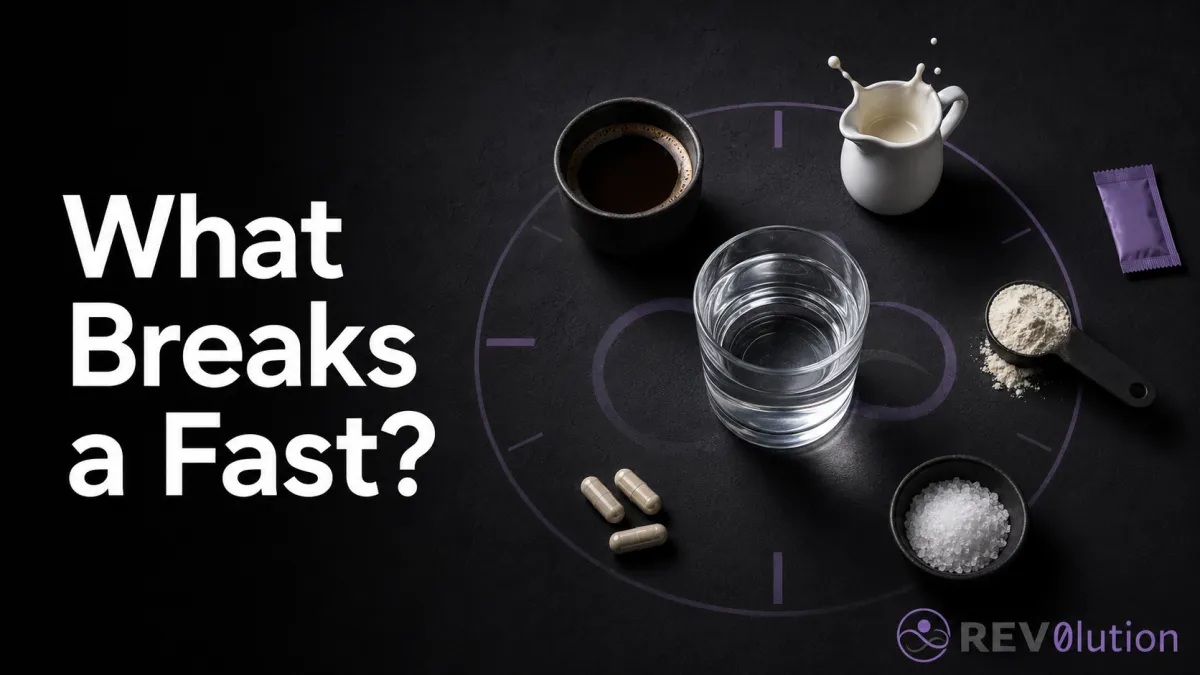
What Breaks a Fast? Coffee, Cream, Supplements, and the Truth About “Clean” Fasting
What Breaks a Fast? Coffee, Cream, Supplements, and the Truth About “Clean” Fasting
Written by Kerri Rachelle, PhD(c), RDN, CSSD, FMP-AC
Founder & CEO, REV0lution | Doctor of Integrative & Natural Medicine Candidate
Quick Answer
Any food or beverage containing calories technically breaks a strict zero-calorie fast. Water and plain, unsweetened coffee or tea are commonly included in everyday intermittent-fasting schedules, although coffee is not appropriate before many fasting blood tests. Milk, cream, sugar, collagen and protein powders provide energy and end a strict fast—but the practical significance depends on why you are fasting.
Key Takeaways
“Breaking a fast” means different things in different contexts.
Plain water is the safest beverage for a diagnostic fast.
Black coffee and unsweetened tea contain very little energy but can still affect glucose, digestion, sleep and certain test results.
Milk, cream, sugar, collagen and protein powders technically end a zero-calorie fast.
Calorie-free electrolytes generally do not end a dietary fast, but ingredients and medical conditions matter.
Artificial sweeteners are not necessarily metabolically or microbiologically inert, and we do not recommend them during a fast.
Medication safety is more important than preserving a fasting window.
A splash of milk does not erase the hours you already spent fasting.
You are 13 hours into a planned 14-hour fast and add a splash of milk to your coffee.
Did you break the fast? Technically, yes. Did you erase the previous 13 hours? No. Did your metabolism reset to zero? Absolutely not.
The question “What breaks a fast?” sounds simple, but the answer depends on why you are fasting. The rules for fasting bloodwork are not the same as the rules for an everyday time-restricted-eating schedule. Religious fasting has its own requirements. A research protocol may define fasting differently from someone whose primary goal is to stop eating after dinner.
This is where fasting culture has become unnecessarily confusing. Foods and beverages are often classified as either perfectly “clean” or capable of ruining the entire fast. Human metabolism does not operate that way. Fasting is not an on-and-off switch. The body responds to food, energy and nutrients along a continuum.
If you need the foundation first, read What Is Intermittent Fasting?. If you are trying to establish a realistic beginner schedule, start with How to Start Intermittent Fasting Without Making It Miserable.
What Does “Breaking a Fast” Actually Mean?
A fast is a period in which food or energy intake is restricted, but not every fasting approach uses the same definition. Before deciding whether something “counts,” you need to know which type of fast you are discussing.
A clean fast should be simple. Water is the standard; plain coffee or unsweetened tea may be reasonable depending on your goal. Once the fasting window requires sweeteners, flavored powders, collagen, creamers and multiple supplements, you are no longer keeping the fast clean—you are trying to recreate eating without calling it eating.
A strict zero-calorie fast
In a strict zero-calorie fast, no food or caloric beverages are consumed.
Under this definition:
Milk breaks the fast.
Cream breaks the fast.
Sugar and honey break the fast.
Collagen breaks the fast.
Protein powder breaks the fast.
Butter, oil and MCT oil break the fast.
It does not matter whether the calories come from carbohydrate, protein or fat. A food does not remain part of a zero-calorie fast simply because it produces a smaller glucose response.
A water-only fast
A water-only fast is even more specific: only plain water is consumed. Black coffee, tea, flavored water and supplements would not meet a true water-only definition, even if they contain no meaningful calories.
A modified fast
Some fasting protocols intentionally allow a limited amount of food or energy.
Examples include:
Modified alternate-day fasting
Some clinically supervised fasting programs
Fasting-mimicking diets
Research protocols allowing a defined number of calories
These may still be studied or described as fasting interventions, but they are not zero-calorie fasts.
A practical time-restricted-eating schedule
Many people use intermittent fasting primarily to:
Stop eating late at night
Shorten the daily eating window
Reduce snacking
Create more consistent meal timing
Support weight management
In that context, a small amount of milk in morning coffee may technically end a zero-calorie fast without meaningfully changing whether the overall schedule helps reduce late-night eating or total intake. Technical accuracy matters, but it should not be confused with clinical significance.
Why Are You Fasting?
Before analyzing your coffee, supplement or piece of gum, ask why you are fasting.
Are you preparing for bloodwork?
Follow the exact instructions from the ordering clinician or laboratory. Plain water is generally the only beverage permitted. Coffee, tea, flavored water, gum and supplements may affect certain results.
Are you using time-restricted eating for weight management?
The overall eating pattern matters more than chasing fasting purity. The relevant questions include:
Is the schedule reducing unplanned eating?
Are you consuming less overall?
Can you meet your nutritional needs?
Is the plan sustainable?
Are coffee additions contributing a splash—or several hundred calories?
Are you trying to improve glucose regulation?
Food, beverage and caffeine responses can vary. Some people may also be using a glucose meter or continuous glucose monitor to understand their individual response. A lack of a visible glucose spike does not necessarily mean that nothing happened metabolically. Likewise, a small temporary change does not mean the entire fasting period was useless.
Are you pursuing ketosis?
Ketosis and fasting are related, but they are not identical. Someone may remain in ketosis after consuming certain calories, particularly fat. That does not mean the person is still following a zero-calorie fast.
Are you following a religious fast?
Religious fasting rules vary by faith, tradition and observance. Some prohibit both food and water, while others permit water or certain foods. Religious guidance—not an intermittent-fasting influencer—determines whether something breaks that fast.
Does your medication require food?
Take the medication as directed. Do not skip necessary food or alter medication timing to protect a fasting streak. The strictest possible fasting rule is not automatically the healthiest rule for every purpose.
Does Water Break a Fast?
Plain water does not break a dietary fast and is generally encouraged during ordinary intermittent fasting.
This includes:
Still water
Plain mineral water
Plain sparkling water
Adequate hydration may help reduce headaches, constipation and symptoms that are sometimes incorrectly attributed to “detoxing.” However, the word “water” on a label does not guarantee that the beverage is plain.
Check flavored, enhanced and electrolyte waters for:
Added sugar
Fruit juice
Carbohydrate
Amino acids
Sweeteners
Caloric flavoring ingredients
A squeeze of lemon contributes a very small amount of energy. It technically changes a strict water-only fast, but its practical significance for everyday time-restricted eating is minimal.
For fasting bloodwork, the safest choice is plain water. MedlinePlus advises avoiding coffee, soda, juice and flavored beverages because their ingredients may enter the bloodstream and affect certain test results. MedlinePlus
“Basically water” is not the same as plain water when preparing for a medical test.
Does Coffee Break a Fast?
Plain black coffee contains very little energy and is commonly included in everyday intermittent-fasting schedules. For someone using fasting to create an overnight eating break or reduce late-night eating, black coffee is unlikely to determine whether the overall strategy succeeds. But “contains very few calories” does not mean “has no physiological effect.”
Caffeine may:
Temporarily affect insulin sensitivity
Influence an individual’s glucose response
Suppress appetite
Increase shakiness or anxiety
Worsen reflux or nausea
Affect bowel activity
Disrupt sleep when consumed later in the day
Research suggests that acute caffeine intake can temporarily reduce insulin sensitivity in some people, even though habitual coffee consumption has a different and more complex relationship with long-term health. This does not mean everyone needs to avoid coffee while fasting. It means coffee should not be described as metabolically invisible. Black coffee is permitted during many forms of intermittent fasting, but it is not required. If coffee worsens anxiety, reflux, shakiness, palpitations or hunger—especially on an empty stomach—do not force it simply because fasting culture treats coffee as a free pass.
What if coffee helps suppress hunger?
There is a difference between coffee making a mild morning appetite easier to manage and using repeated caffeine to ignore severe hunger. If you are shaky, nauseated, distracted or intensely hungry, eat. Do not keep adding coffee because your eating window has not opened. Coffee should not become a substitute for adequate nutrition.
Does decaffeinated coffee break a fast?
Plain decaffeinated coffee also contains very little energy and is commonly included in everyday time-restricted eating. It may be better tolerated by people who experience anxiety, palpitations, reflux or glucose changes from caffeine. However, decaffeinated coffee is still not the same as water and may not be permitted before fasting laboratory tests.
Can you drink coffee before fasting bloodwork?
Unless your laboratory specifically says otherwise, choose plain water. Coffee—including black coffee—may influence certain laboratory values. Test requirements vary, so the instructions for the specific test take priority over general intermittent-fasting advice.
Does Tea Break a Fast?
Plain, unsweetened tea contains very little energy and is generally included in everyday intermittent-fasting schedules.
Common options include:
Black tea
Green tea
White tea
Plain herbal tea
However, tea products can become caloric quickly.
Check for:
Milk or cream
Honey
Sugar
Sweetened tea concentrates
Fruit juice
Powdered drink mixes
Tea lattes
Bottled teas with added ingredients
Herbal teas may also contain botanicals that interact with medications or affect certain tests. “Natural” does not mean physiologically irrelevant. As with coffee, tea is generally not recommended during a diagnostic fast unless the clinician or laboratory specifically permits it.
Does Cream or Milk in Coffee Break a Fast?
Yes. Milk and cream contain calories and technically end a strict zero-calorie fast.
This includes:
Dairy milk
Half-and-half
Heavy cream
Oat milk
Almond milk
Coconut milk
Flavored creamers
“Sugar-free” creamers
Plant-based does not mean calorie free, and sugar free does not necessarily mean calorie free. But the amount matters when we consider practical significance. A measured tablespoon of milk is not metabolically equivalent to a large flavored latte. The tablespoon technically ends the zero-calorie fast, but it does not erase the hours that came before it or make the entire day metabolically meaningless.
On the other hand, several large coffees containing generous pours of milk, cream or flavored creamer can contribute a meaningful amount of energy. At that point, someone may be maintaining a liquid eating window while believing they are fasting. Serving sizes also matter. A creamer label may list nutrition information for one tablespoon, while the actual pour contains three or four.
Cream, milk and flavored creamers contain energy and technically break a fast. If you need cream to tolerate coffee, either acknowledge that you are practicing a modified fast or intentionally break the fast with a nourishing meal. Precision is more useful than pretending.
Does a splash of milk stop fat burning?
It may temporarily alter the mixture of fuels your body uses, but it does not permanently “turn off” fat burning. The body continually moves between using and storing different fuels. It does not burn only fat during a fast and only glucose after eating.
Does milk reset the fasting clock?
If you are tracking a strict zero-calorie fast, then yes—you consumed calories, and the fast technically ended. But your physiology did not reset to the condition it was in immediately after your previous full meal. You still spent the preceding hours without food. Your metabolism is not a timer that returns to zero when milk touches your coffee.
Do Collagen and Protein Powder Break a Fast?
Yes. Collagen, amino acids and protein powders break a fast. They provide calories and initiate digestive, metabolic and nutrient signaling. They may be useful products in the appropriate context, but the fasting window is not that context—particularly when autophagy is the goal. Collagen in coffee may be convenient, and a protein shake may be a nutritionally useful way to end a fast, but neither should be described as fasting.
This includes:
Collagen peptides
Whey protein
Casein protein
Plant-based protein powders
Essential amino acids
Branched-chain amino acids
Breaking a fast with protein is not inherently bad. In fact, consuming adequate protein may be more important for muscle maintenance, recovery and satiety than extending an arbitrary fasting window. The issue is accuracy—not morality. Protein can be a smart way to break a fast. It simply does not preserve a zero-calorie fast.
Do Butter, MCT Oil or “Bulletproof” Coffee Break a Fast?
Yes. Butter, coconut oil and MCT oil contain calories and break a strict zero-calorie fast. Because dietary fat generally produces a smaller immediate glucose response than carbohydrate, fat-containing coffee is sometimes marketed as a way to consume energy without “breaking” a fast. That confuses glucose response with fasting.
A tablespoon of oil supplies energy whether or not glucose rises significantly. Someone may remain in ketosis after consuming MCT oil or butter, but ketosis and fasting are not the same state. Oil is also energy dense. A coffee containing butter, oil and cream may contain as much energy as a small meal while still being recorded as part of the fasting window. A beverage does not remain a fast simply because its calories come from fat.
Do Electrolytes Break a Fast?
Pure, calorie-free electrolytes generally do not break an everyday dietary fast. However, electrolyte products can contain more than sodium, potassium and magnesium. Check the label for:
Calories
Total carbohydrate
Added sugar
Dextrose
Maltodextrin
Amino acids
Juice powders
Caloric flavoring ingredients
Serving size
A product can be labeled “sugar free” and still contain carbohydrate fillers, sweeteners or other ingredients that may not fit a strict fasting protocol.
Do you need electrolytes during intermittent fasting?
An ordinary 12- to 16-hour overnight fast does not automatically require an electrolyte supplement. Someone eating adequate food, drinking water and fasting for part of the day will usually continue consuming sodium, potassium and magnesium during the eating window. Longer fasts, intense exercise, heat exposure, heavy sweating and certain medical conditions create different considerations. Plain electrolytes may be appropriate in those situations or under clinical guidance. Most people completing a routine overnight fast do not need a brightly flavored “fasting electrolyte” product. Read the label: sugar, dextrose, maltodextrin, artificial sweeteners, flavors and unnecessary additives do not become health-promoting simply because the container says “fasting.”
More electrolytes are not always better.
Excess sodium may be inappropriate for some people with hypertension, heart failure or kidney disease.
Supplemental potassium can be dangerous with kidney disease or medications that affect potassium regulation.
Magnesium may cause diarrhea or gastrointestinal discomfort, particularly on an empty stomach.
Diuretics and certain blood-pressure medications can alter hydration and electrolyte balance.
“Fasting electrolytes” are not automatically necessary—or automatically safe—because the label says fasting.
Do Vitamins and Supplements Break a Fast?
It depends on what the supplement contains.
Supplements that contain calories
These technically break a strict fast:
Fish oil
Gummy vitamins
Collagen
Protein powders
Amino-acid supplements
Supplements delivered in caloric oils
Fiber products containing sugar or digestible carbohydrate
Even when the calorie amount is small, the supplement no longer fits a strict zero-calorie definition.
Supplements with little or no caloric content
Some mineral tablets, capsules and unsweetened electrolyte products contain little or no meaningful energy. They may not technically break an everyday dietary fast. But that is not the only question that matters. Some supplements are better absorbed or tolerated with food. Multivitamins, zinc, fish oil and fat-soluble vitamins may cause nausea or be more appropriately consumed with a meal. Iron instructions vary according to the formulation, the person’s tolerance and the reason it was prescribed.
Most supplements do not need to accompany a short daily fast. Fat-soluble vitamins, fish oil and supplements that cause nausea are generally better taken with food. Instead of forcing an entire supplement routine into the fasting window, move it to a meal unless a qualified clinician has instructed you otherwise. Do not compromise absorption, create unnecessary nausea or ignore clinical instructions solely to preserve a fasting window.
Do Medications Break a Fast?
Do not skip or delay prescribed medication to protect a fast. Your medication schedule is more important than fasting purity. Some medications must be taken with food, and taking them without food may impair absorption or cause nausea, gastrointestinal irritation or hypoglycemia.
Some medications:
Must be consumed with food
Can irritate the stomach when taken without food
Affect glucose or blood pressure
Increase urination or dehydration risk
Require consistent timing
Can cause hypoglycemia when meals are skipped
Insulin, sulfonylureas and meglitinides can increase the risk of low blood glucose when someone delays or skips meals. Diuretics and some blood-pressure medications can also create additional concerns during longer or fluid-restricted fasts. Do not stop, delay or alter medication because an app says your fasting window is still open. Medication changes must be made with the prescribing clinician.
A functional medicine registered dietitian can help evaluate whether a fasting schedule supports your nutritional and metabolic needs, but medication adjustments remain the responsibility of the prescribing healthcare professional. Never skip necessary food or medication to display a longer fasting time.
Do Artificial Sweeteners Break a Fast?
Artificial sweeteners may contain few or no calories, but I do not recommend using them during a fast—or routinely outside one. The absence of calories does not make an artificial ingredient healthy, metabolically neutral or supportive of the gut.
Some controlled studies have found little immediate change in glucose or insulin when certain nonnutritive sweeteners are consumed alone. Other human research has raised concerns about changes in insulin sensitivity, glucose tolerance and the gut microbiome, particularly with sweeteners such as sucralose and saccharin.
More importantly, “it did not immediately spike my glucose” is far too low a standard for deciding whether something belongs in your diet. My position is straightforward: choose real food and unsweetened beverages over artificial substitutes.
Check the complete product
Sweetener packets and drink mixes may contain:
Dextrose
Maltodextrin
Sugar alcohols
Carbohydrate fillers
Multiple sweeteners
Flavoring ingredients
The amount in one packet may be small, but the product is not necessarily metabolically identical to the pure sweetener studied in research.
Do artificial sweeteners trigger an insulin response?
Some artificial sweeteners may influence insulin, glucose regulation and related metabolic signaling, but responses vary by sweetener, formulation and individual physiology. Not every artificial sweetener reliably produces an immediate insulin spike when consumed alone.
However, that does not make artificial sweeteners harmless. Human research has raised legitimate concerns about changes in insulin sensitivity, glucose tolerance and the gut microbiome with certain sweeteners, including sucralose and saccharin.
We do not recommend artificial sweeteners simply because they contain no sugar or calories. They are manufactured substitutes, not foods the body needs. When possible, skip the fake sweetness and choose unsweetened beverages or real, minimally processed food.
The goal should not be to find the most technically permissible artificial ingredient. The goal should be to build a healthier relationship with real food and allow the palate to adjust to less sweetness.
What about appetite and cravings?
Artificial sweeteners keep the brain and palate accustomed to an unnaturally intense level of sweetness. Even if a diet drink makes fasting feel easier in the moment, it may preserve the very craving cycle someone is trying to change. Some people notice immediate hunger or cravings after consuming artificial sweeteners; others do not. But the absence of an obvious short-term reaction does not prove that routinely consuming intensely sweet artificial ingredients is beneficial.
Fasting should help create space between eating occasions—not become a period filled with diet drinks, artificially flavored powders and “zero-sugar” products. Allowing the palate to adjust to less sweetness can make naturally sweet, minimally processed foods more satisfying over time.
Do artificial sweeteners stop autophagy?
We do not have sufficient human evidence to prove that a particular artificial sweetener completely stops autophagy. But if your goal is to support the body’s natural cellular cleanup and recycling processes, why introduce unnecessary artificial sweeteners and manufactured additives during that window?
Autophagy is not measured by whether a drink contains zero calories or whether your continuous glucose monitor remains flat. An artificially sweetened product may include sweeteners, flavoring agents, colors, preservatives and other additives that provide no nutritional benefit.
If autophagy is your goal, keep the fast genuinely clean:
Water
Plain mineral or sparkling water
Black coffee
Plain, unsweetened tea
Do not let “zero calories” distract you from the larger purpose of the fast. If you are intentionally giving your body a break and supporting cellular cleanup, adding manufactured sweeteners and unnecessary additives works against the spirit of that goal—even when science cannot yet quantify the effect of every ingredient on human autophagy.
We do not need proof that every artificial additive definitively shuts autophagy off before deciding it does not belong in a clean fast. Keep the window simple and stop looking for loopholes.
Do Gum and Mints Break a Fast?
Sugar-containing gum and mints provide calories and technically end a strict zero-calorie fast.
Sugar-free versions may contain:
Sugar alcohols
Artificial sweeteners
Small amounts of carbohydrate
Caloric flavoring ingredients
One piece of sugar-free gum is unlikely to determine someone’s long-term metabolic outcome. However, gum can stimulate hunger or cause bloating and diarrhea in some people—particularly when larger amounts of sugar alcohols are consumed. Gum and mints may also be prohibited before certain blood tests or procedures. Follow the specific instructions you were given.
Why Does Fasting for Bloodwork Have Different Rules?
If a clinician or laboratory tells you to fast, follow those instructions—not general advice about intermittent fasting. Water is generally the safest choice. Coffee, supplements, gum, nicotine, exercise and flavored beverages may affect certain results even when they contain few or no calories.
For many fasting blood tests:
Plain water is permitted.
Coffee and tea should be avoided.
Milk, cream, sugar and juice should be avoided.
Gum and mints may not be permitted.
Supplements may need to be delayed.
Medication instructions must be individualized.
Food, caffeine, supplements and medications can affect different tests in different ways. Preparation may be particularly important when measuring glucose, insulin, triglycerides or specialized metabolic and hormone markers.
The required fasting duration also varies. Do not assume that every fasting test requires 12 hours, and do not fast longer than instructed in an attempt to produce a “better” result. Longer fasting can create a result that is less representative of your usual physiology.
If you are unsure, contact the ordering clinician or laboratory before the test. Never stop a prescribed medication unless the appropriate healthcare professional tells you to do so.
Religious Fasting Has Its Own Definition
Religious fasting cannot be defined by a general nutrition article. Rules vary by faith, denomination, tradition and individual observance. Some fasting practices prohibit both food and water. Others allow water, particular foods or eating during specified hours. Medical exemptions or modifications may also exist.
Follow the guidance of your faith tradition and discuss medical safety with your healthcare team when needed. A coffee that fits an everyday time-restricted-eating schedule may not meet the requirements of a religious fast.
What About Ketosis, Fat Burning and Autophagy?
These terms are often used as if they mean the same thing. They do not.
Ketosis
Ketosis means the body is producing an elevated amount of ketones. A person may remain in ketosis after consuming some fat or a small number of calories. That does not mean the person is still following a zero-calorie fast.
Fat burning
The body uses a mixture of carbohydrate and fat throughout the day. The proportion changes according to food intake, activity, glycogen availability and metabolic health. Adding milk to coffee may temporarily change fuel use, but it does not permanently “turn off” fat burning. Similarly, fasting does not mean the body is using only stored body fat.
Autophagy
Autophagy is an ongoing cellular maintenance and recycling process. Fasting may influence it, but human research has not established a precise hour at which autophagy suddenly begins. We also cannot tell someone that coffee, cream or a specific sweetener definitively stops or preserves autophagy in humans. Ketosis, fat burning, autophagy and fasting are related concepts, but they are not interchangeable.
Does a Splash of Milk Ruin Your Fast?
A splash of milk technically ends a zero-calorie fast.
It does not:
Erase the previous fasting period
Reset your metabolism
Permanently stop fat burning
Guarantee an insulin spike
Cause immediate fat gain
Make the entire day meaningless
The practical questions are:
Why are you fasting?
How much milk are you actually using?
Is it one measured splash or several large cream-based coffees?
Are you preparing for bloodwork?
Does coffee worsen hunger, reflux or anxiety?
Is the addition helping you maintain a sustainable schedule?
Is the pursuit of fasting purity creating unnecessary stress?
Your metabolism is not a timer that resets to zero when you add milk to coffee.
When “Clean Fasting” Becomes More Stressful Than Useful
“Clean fasting” is not a standardized scientific or medical category. It is an internet term used to describe a strict approach that usually permits only water, black coffee and plain tea. There is nothing wrong with choosing a zero-calorie fasting period. The problem begins when precision turns into fear or perfectionism.
Warning signs include:
Feeling anxious about trace calories
Restarting the fasting timer after a mint
Feeling guilty about milk in coffee
Ignoring intense hunger
Exercising despite dizziness
Delaying necessary medication
Compensating with a longer fast the following day
Choosing fasting purity over adequate nutrition
Avoiding social situations
Becoming increasingly preoccupied with food and time
A fasting schedule should make eating more stable. If it makes food more mentally consuming, the schedule is not serving its purpose. Precision can support a medical or research protocol. Perfectionism does not automatically support health. Fasting should not become a hunt for technical loopholes. At the same time, one imperfect choice does not erase every benefit of the day. Be honest about what you are doing: water, plain coffee and unsweetened tea fit a conventional clean fast; cream, milk, collagen, protein and other calories break it; and artificially sweetened products introduce unnecessary ingredients that do not belong in the fasting window I recommend.
A Practical “Does This Break My Fast?” Guide
The Bottom Line
If you choose to fast, keep it clean and uncomplicated. Drink water. Use plain coffee or unsweetened tea if they agree with you. Take medications as prescribed. Move food and caloric supplements into your eating window—and leave artificial sweeteners out altogether.
A splash of milk does not erase your entire day, but it does technically break a strict fast. Collagen and protein powders break a fast. Prescribed medications should never be skipped or delayed to protect one.
Most importantly, fasting should not require a collection of flavored powders, diet drinks and appetite tricks. If that is what you need to endure the fasting window, the schedule may not fit your body or your life. Eat real food and choose a more sustainable approach.
Medical Disclaimer: This article is for general educational and informational purposes only and does not provide individualized medical or nutrition advice. It is not intended to diagnose, treat, cure, or prevent disease or replace care from a qualified healthcare professional. Do not change your medications, supplements, diet, fasting schedule, or healthcare plan based solely on this content. [Read the full Medical Disclaimer and Terms & Conditions.] Fasting may not be appropriate for everyone and may require medical supervision or medication adjustments, particularly for people with diabetes, a history of disordered eating, pregnancy or breastfeeding, on certain medications or medical conditions affected by food, fluid, or electrolyte intake.
Frequently Asked Questions
What breaks a fast?
Any food or beverage containing calories technically breaks a strict zero-calorie fast. This includes milk, cream, sugar, collagen, protein powder, butter, MCT oil and caloric supplements. The practical significance depends on why you are fasting.
Does black coffee break a fast?
Black coffee contains very little energy and is commonly allowed during everyday intermittent fasting. However, caffeine can affect glucose regulation, digestion, anxiety and sleep, and coffee may not be permitted before fasting bloodwork or medical procedures.
Does cream in coffee break a fast?
Yes. Cream contains calories and technically ends a zero-calorie fast. A measured splash does not erase the preceding hours without food, but several cream-based coffees can contribute a meaningful amount of energy.
Does milk break intermittent fasting?
Milk contains carbohydrate, protein and calories, so it ends a strict fast. The metabolic significance of a tablespoon of milk is different from that of a large latte, particularly when the goal is simply to create a consistent overnight eating break.
Do artificial sweeteners break a fast?
Artificial sweeteners may contain few or no calories, but we do not recommend using them during a fast—or routinely outside one. The absence of calories does not make an artificial ingredient healthy, metabolically neutral or supportive of the gut. Research suggests that certain artificial sweeteners may affect glucose tolerance, insulin sensitivity, appetite signaling and the gut microbiome. Not every sweetener produces an immediate, measurable insulin spike in every person, but that is far too low a standard for deciding whether something belongs in your diet.
Our position is straightforward: choose real food over artificial substitutes.
Artificially sweetened drinks, flavor drops, fasting powders and “zero-sugar” products often keep the palate dependent on intensely sweet flavors. They may also make fasting unnecessarily complicated by replacing food with a collection of manufactured ingredients.
If you want to maintain a clean fast, choose:
Water
Plain sparkling water
Black coffee
Plain, unsweetened tea
If you are struggling to fast without sweetened products, consider whether the fasting schedule is actually serving you. It may be better to break the fast intentionally with real, nourishing food than to force your way through it using artificially sweetened drinks and powders. “Zero calories” is a marketing statement. It is not evidence that a product is good for your metabolism, your microbiome or your long-term health.
Do electrolytes break a fast?
Pure, calorie-free electrolytes generally do not break an everyday dietary fast. Products containing sugar, carbohydrate, amino acids or juice powder do. Electrolyte supplementation is not automatically necessary for an ordinary overnight fast.
Does collagen break a fast?
Yes. Collagen provides protein, amino acids and calories, so it ends a strict zero-calorie fast. Collagen may be a convenient way to add protein, but it should be considered part of the eating window.
Does protein powder break a fast?
Yes. Protein powder provides calories and amino acids that stimulate digestion and nutrient signaling. A protein shake can be a useful way to break a fast, but it does not preserve one.
Does MCT oil break a fast?
Yes. MCT oil contains calories and ends a zero-calorie fast. Someone may remain in ketosis after consuming MCT oil, but remaining in ketosis is not the same as remaining fasted.
Do vitamins break a fast?
Some vitamins and mineral tablets contain little or no energy, while gummies, fish oil and oil-based supplements provide calories. Absorption, tolerance and clinical instructions are more important than preserving a fasting timer.
Can I take medication while fasting?
Take medication according to the prescribing clinician’s instructions. Some medications require food, while insulin and certain diabetes medications can increase hypoglycemia risk when meals are delayed. Never change medication timing to preserve a fast without clinical guidance.
Does gum break a fast?
Sugar-containing gum provides calories and technically breaks a strict fast. Sugar-free gum may contain sugar alcohols or small amounts of carbohydrate. One piece is unlikely to determine a long-term metabolic outcome, but it may not be permitted before bloodwork or a procedure.
Can I drink coffee before fasting bloodwork?
Do not assume that black coffee is permitted before bloodwork. Coffee and caffeine may affect certain laboratory values. Follow the exact instructions from the ordering clinician or laboratory; plain water is generally the safest choice.
Does a splash of milk ruin the benefits of fasting?
No. It technically ends a zero-calorie fast, but it does not erase the previous fasting period or reset your metabolism. Its practical importance depends on the amount consumed and the purpose of the fast.
Does anything other than water stop autophagy?
Human research has not established a precise fasting duration or a definitive list of ingredients that stop or preserve autophagy. However, if autophagy is your goal, keep the fasting window as clean and simple as possible. Choose water, plain mineral water, black coffee or unsweetened tea rather than introducing calories, artificial sweeteners or manufactured additives. Uncertainty is not a reason to search for loopholes.
References
Koppold DA, et al. International consensus on fasting terminology. Cell Metabolism. 2024. This consensus distinguishes fasting, modified fasting, intermittent fasting, time-restricted eating and other fasting approaches. PubMed
Sciarrillo CM, et al. The effect of black coffee on fasting metabolic markers and an abbreviated fat-tolerance test. 2021. This study examined whether consuming black coffee before laboratory testing affected fasting glucose and triglyceride measurements. PubMed
Shi X, et al. Acute caffeine ingestion reduces insulin sensitivity in healthy subjects: a systematic review and meta-analysis. Nutrition Journal. 2016. Acute caffeine intake was associated with temporarily reduced insulin sensitivity. PubMed
Reis CEG, et al. Effects of coffee consumption on glucose metabolism: a systematic review of clinical trials. Journal of Traditional and Complementary Medicine. 2019. The review found that caffeinated coffee may have unfavorable acute glucose effects, while longer-term findings were more complex. PubMed
Greyling A, et al. Acute glycemic and insulinemic effects of low-energy sweeteners: a systematic review and meta-analysis of randomized controlled trials. American Journal of Clinical Nutrition. 2020. Low-energy sweeteners consumed without additional energy generally produced glucose and insulin responses similar to controls. PubMed
Zhang R, et al. The effect of non-nutritive sweetened beverages on postprandial glycemic and endocrine responses: a systematic review and network meta-analysis. 2023. Nonnutritive-sweetened beverages generally produced acute metabolic responses similar to water. PubMed
Corley BT, et al. Intermittent fasting in type 2 diabetes mellitus and the risk of hypoglycaemia: a randomized controlled trial. Diabetic Medicine. 2018. Fasting increased hypoglycemia risk in adults using glucose-lowering medication, despite education and medication adjustment. PubMed
Uldal S, et al. Is time-restricted eating safe in the treatment of type 2 diabetes? A review of intervention studies. 2022. Time-restricted eating may be feasible for some people with type 2 diabetes when medications and glucose are appropriately monitored. PubMed
Wang Y, Wu R. The effect of fasting on human metabolism and psychological health. Disease Markers. 2022. This review describes the metabolic changes occurring across fasting durations and the limits of translating fasting mechanisms into clinical promises. PubMed
Bensalem J, et al. Intermittent time-restricted eating may increase autophagic flux in humans. 2025. This emerging human research suggests a possible effect on autophagic activity but does not establish a universal fasting timetable. PubMed